
5 | The Making of the 1872 Census: Process and Scope
By Gaurav Kalyani and Shivakumar Jolad (author details below)
The 1871–72 census was the first significant attempt at a systematic enumeration across the Indian Empire, although it was ultimately non-synchronous and geographically incomplete. While the original intent of the Government of India was to conduct a simultaneous count on November 15, 1871, the actual enumeration took place on various dates between late 1871 and mid-1872. For example, the North-Western Provinces conducted its count on January 18, 1872, Bombay on February 21, 1872, and British Burma as late as August 15, 1872 (Maheshwari, 1996; Waterfield, 1875).
There was no central Census Commissioner for the 1871–72 operation; instead, the census was managed by provincial governments under general direction from the Government of India. At the local level, District Collectors or Magistrates were the primary officers responsible for the census within their jurisdictions. The administrative machinery relied heavily on unpaid, local agencies (village heads, priests, police force, school teachers etc.). In rural areas of many provinces, the Putwaree (village accountant) served as the primary enumerator due to their intimate knowledge of residents' domestic concerns. In urban areas, the machinery utilized Mohulladars (ward heads) or other respectable inhabitants. However, in Bengal, the lack of a sub-district revenue machinery forced the government to rely on the police to supervise residents who were requested to act as enumerators (Maheshwari, 1996; Waterfield, 1875).
The enumeration process generally followed a standardized two-step methodology:
Preliminary Record: Conducted weeks or months before the official date, enumerators visited every house in their assigned beat to record the names, castes, and occupations of usual residents.
Final Enumeration: On the designated ‘census moment’, typically a moonlit night to facilitate travel and visibility, enumerators performed a final round. They updated the preliminary record by striking out those who had died or departed and adding newborns or guests.
The 1871–72 general census was not truly synchronous across all territories. In provinces like Punjab, Oude (Awadh), and Berar, new enumerations were not carried out because it was thought undesirable to disturb the population so soon after their recent provincial counts in 1867–1869. Furthermore, in the non-regulation divisions of Chota Nagpore (Chota Nagpur) and Assam, the lack of administrative machinery meant the enumeration took several months to complete rather than a single night.

Extensive correspondence between the Collectors revealed that there was debate regarding the best agency to use. While voluntary agency was considered, it was largely rejected in favor of government servants (unpaid) and paid enumerators to ensure accuracy. A significant debate centered on whether to number by ‘houses’ or ‘enclosures’ (a group of houses within one boundary), ultimately settling on local variations based on district needs. To ensure the clarity among the vast number of enumerators, the instructions and forms were translated into dominant vernacular languages. For example, in the Bombay Presidency, Marathi, Gujarati, Kannada, Urdu, Sindi, and Arabic were used. Officials also expressed concern that the majority of people being unable to read or write would lead to errors if householders were left to fill in the forms themselves (Report on Census of Bombay Presidency 1872, Part I).
Data collection involved a simple form recording sex, age, religion, caste or class, race, occupation, and literacy. To accommodate social sensitivities, it was decided that providing the names of female family members would be left entirely to the discretion of the head of the household. Throughout the process, officials had to combat wild rumours and absurd stories circulating among the population, such as rumors that the census was a precursor to new taxes, military conscription, or forced labor.
The first census of 1871–72 was conducted because the British administration found that the lack of even approximate knowledge regarding the Indian population had become a serious administrative inconvenience for them. Previous population figures were considered to be vague and untrustworthy conjectures based on land revenue or household averages. While there had been earlier local attempts to count the population, a major shift came in 1856. The Court of Directors urged the Indian Government to conduct a regular decennial census, similar to those in Great Britain and the United States, so that the country could be governed using a uniform system. The 1857 Mutiny delayed the initial 1861 target, the project was revived in 1865 (Maheshwari, 1996; Natarajan, 1971).
The 1871–72 exercise served as an experimental measure to prepare both the public and the administrative machinery for future synchronous decennial cycles. In a country with rapid growth and no internal migration control, the census was intended to provide a necessary ‘anchor test’ for the otherwise unreliable vital statistics recorded by various provinces. The census sought to provide a basis for determining the incidence of local and Imperial taxation and assessing the sufficiency of food supplies for the growing population. Precise data was also necessary to organize adequate judicial and police arrangements, plan for the spread of education, and manage public health initiatives. Ultimately, the 1871–72 census marked the transition from revenue-based intelligence to statistical governance, aiming to understand the demographic, economic, and social condition of the people in British India (Maheshwari, 1996; Natarajan, 1971).

Coverage
For the first time in the subcontinent’s long history, the state attempted to count every single person within its grasp, not just heads, but ages, religions, castes, occupations, infirmities and even the bricks in a house wall.The 1871-72 Census , although flawed, provided nevertheless a fascinating portrait of 190 million people living under the British Raj and another 48 million in the princely states (most princely states were excluded).
It recorded a total population of 239 million people (23,88,30,958 people to be precise) in total across the censured territory spread over 1.45 million square miles. For comparison, the population of the entire United Kingdom at the time was about 31 million. British India alone held six times that number.
The British provinces comprised around 9,04,049 sq. miles of area and an estimated 5,46, 659 sq. miles of area under Princely States. The census recorded not just the raw population but also its distribution across provinces, districts and individual villages (Waterfield, 1875).
The Census count also extended to houses and settlements, recording the number of inhabited houses (37,041,468), the average number of persons per house (5.14), the total number of villages and towns (493,444) (In contrast Census 2011 of India reported 640 districts, around 5500 Tehsils, more than 7000 towns and 6 Lakh + Villages.). This count covers modern India, Pakistan and Bangladesh, but excludes princely states (except Mysore). A detailed classification of settlements by population size, from hamlets of fewer than 200 people to the 44 cities with more than 50,000 inhabitants, was provided. In contrast, Census 2011 of India. The census, thus, aimed to produce an almost complete physical and demographic map of British India, down to the level of the individual dwelling (Waterfield, 1875).

Beyond merely counting numbers, the census attempted to classify India’s social landscape. Every person was recorded by sex and age. Religion was another major category that the census distinguished, classifying the population into Hindus, Muslims (referred to as Mahomedans), Buddhists, Jains, Christians, Jews, Parsees and various ‘others’. Caste received extraordinary attention, with the reports listing hundreds of named castes, and in Bengal alone, the census estimated nearly 1,000 separate castes. Nationality and language were also covered, with detailed tables showing the distribution of Bengalis, Hindustanis, Assamese, Ooryas (Oriya), Punjabis, Burmese, Gonds, Sonthals (Santhals) and other linguistic and ethnic groups. This social inventory was unprecedented in its scope, even though it was not fully accurate (Waterfield, 1875).
The census also gathered extensive economic and infrastructural information. It classified the adult male population by occupation, distinguishing professional, domestic, agricultural, commercial, industrial, labouring and non‑productive categories. For agriculture, the census recorded the extent of cultivated and cultivable land, the number of proprietors versus tenants, and the incidence of land revenue and local cesses down to the acre and per adult male cultivator. Similarly, Education was surveyed (although incomplete), asking whether individuals could read and write or were under instruction (Waterfield, 1875).
The census attempted to record health related data, noting infirmities such as blindness, deaf-mutedness, insanity, idiocy, and leprosy. Last but not least, the census attempted to measure population change over time, comparing its figures with earlier enumerations in various provinces to estimate growth, stagnation or decline (Waterfield, 1875).
Exclusions
For how ambitious the 1872 census was, it excluded a lot, some by choice, and some by oversight. Geographically, vast tracts of the subcontinent were simply never enumerated.
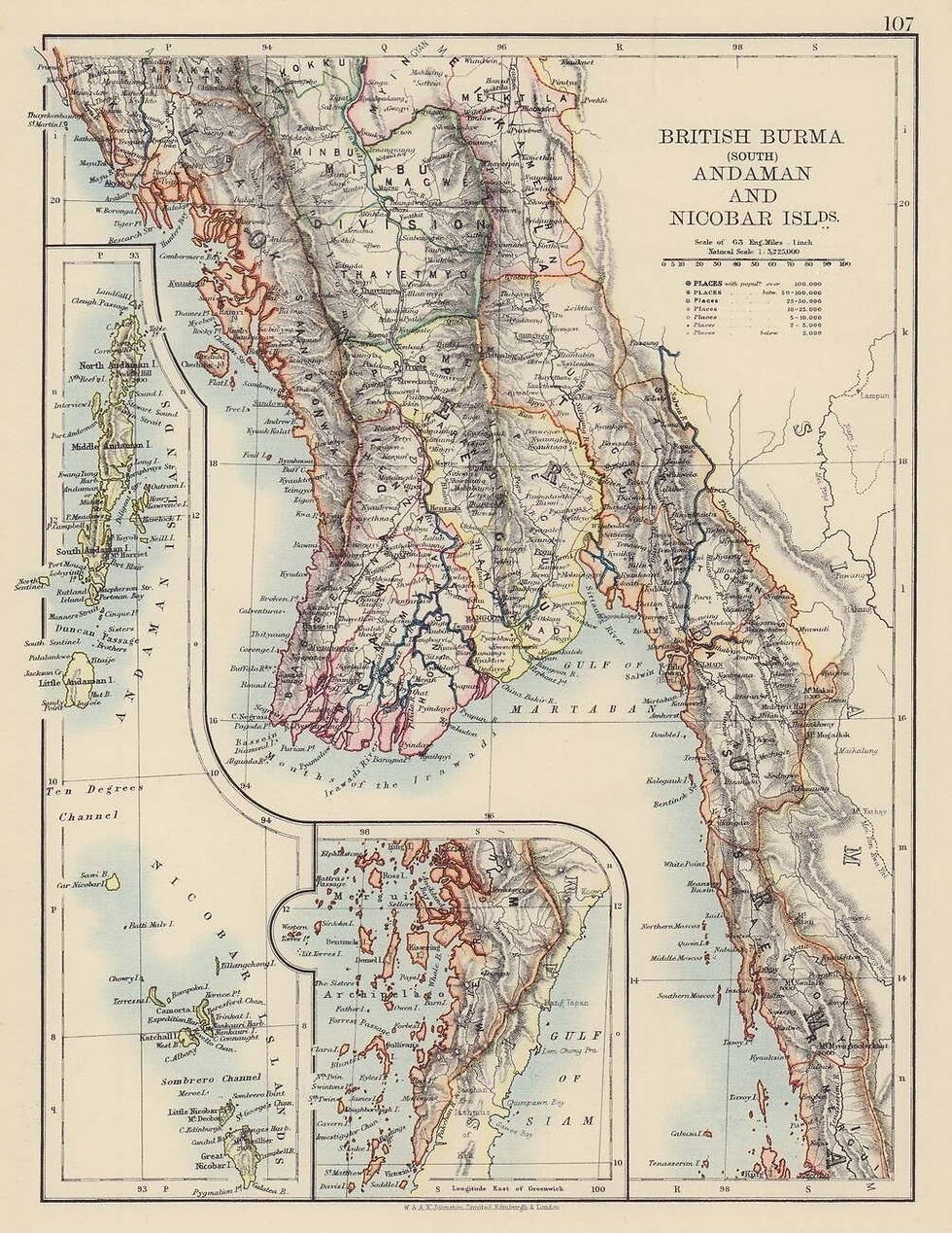
The census explicitly omitted ‘an important tea district’ in Eastern Bengal. The outlying station of Aden in Arabia (estimated population 22,507) (Aden currently in Yemen was under British Indian administration for almost a Century from 1839-1937) and the penal settlement in the Andaman and Nicobar Islands (8,643) were excluded because they were considered “not strictly within Indian limits”.

In Assam, the entire hill districts of Cachar and Lakhmipoor Hills (Cahar and Lakhimpur in Assam), Naga Hills (Nagaland, barring Tuensang), Cossya and Jyntea Hills, and Garo Hills (Khasi, Jaintia and Gharo hill districts- present Meghalaya)– had no census taken at all and only the population estimates were presented. The reasons to exclude these areas were mostly practical, pertaining to expense, lack of administrative machinery and the difficulty of accessing remote, often hostile hill regions. In many districts, such as Panch Mahals, the exclusion of data was due to severe lack of educated local officers who were capable of filling out the complex census forms (Waterfield, 1875).
The Princely State of Khyrpur in Sind was also excluded from the census. Similarly, the states of Cochin and Travancore did not conduct their first formal censuses until 1875, three years after the general operation of 1872. For the vast majority of the Princely States (then known as Feudatory or Native States), accurate statistics were not obtained and were generally not included in the formal, systematic house-to-house enumeration. The census reports explicitly stated that, as a rule, their numbers could only be accepted as conjectural estimates. The primary exception to the exclusion of princely states was Mysore, although it was treated as part of British India for census purposes and underwent a formal enumeration on November 14, 1871(Waterfield, 1875).
Beyond geographic gaps, the census also had temporal and categorical exclusions. For example, the 3 entire provinces of Oudh, Punjab and Berar were excluded and were not enumerated in 1871-72, because of the recent censuses in those provinces in 1869, 1868 and 1867 respectively. Kashmir princely state under Randbir Singh was also not Censusured. Carrying out a new census in provinces that had recently been counted was seen as a waste of funds and would be disturbing to the population in those regions. However, this meant that nearly 30 million people were represented by outdated figures (Waterfield, 1875).
Age was another data point that wasn’t covered in a usable way due to people’s unfamiliarity with the concept of knowing their exact age. Education related data was also irregular across Provinces. Education was not sought at all in Bengal, except for a few municipal towns, while in North West Provinces, girls were entirely excluded from education returns.
Infirmaries were also poorly recorded, to the point that the report admits that the ‘figures cannot be viewed as accurate’ (Waterfield, 1875).
Most strikingly, the significant exclusion was the systematic undercounting of women.
The report acknowledges that some female children and adults were often omitted due their systematic concealment during the process, out of fear or social beliefs. In Ajmer, the sex ratio was recorded at 49 females per 100 males. It was considered so absurd that a fresh census was ordered. Even in Provinces with better data, the census report admits that the number of girls is understated and many were probably counted as adult women.
The missing data on women is a reflection of what the census could not see – households that hid girls, enumerators who did not record their names and a society where women’s lives were rendered invisible (Waterfield, 1875).
These exclusions occurred for various reasons such as lack of funding, public distrust and concerns for safety, remote locations and lack of adequate personnel.
Cost and Legacy
The total cost of the census was £82,203 for a population of 171,860,386 (excluding some feudatory states where counting occurred). Provincial costs ranged from £21,630 for Bengal and Assam to merely £77 for Ajmer. The report also made several recommendations for the next census, which was planned for 1881. It recommended that more accurate classification was needed for religion and caste. It also recommended adoption of a uniform system of classification across all provinces (Waterfield, 1875).
Reading these documents today, one senses the administrators' genuine excitement at the scale of their achievement, alongside their frustration at its imperfections. What they could not anticipate was how their categories would come to shape Indian society in return. A brief report presented in the Royal Statistical Society, years after the census in 1876, perfectly captures the nature, scope and success of the 1872 census:
“The extent of territory covered by the latest and only general inquiry is so vast, the figures involved are so large, the diversity of races, sects and communities are so complex and bewildering, and all the conditions of the problem to be solved are so inherently difficult of solution”….yet “A careful scrutiny of the figures shows that this census must be regarded more as a creditable, and in the main successful attempt to deal with an exceptionally difficult subject, than as a complete or reliable statement of a class of facts which demands the most vigorous exactness and scientific precision in its treatment.”
A Milestone
The 1872 census stands as a transformative milestone in India’s administrative history, establishing a first data line for the country’s statistical record. While there were many flaws and shortcomings in this operation, it nevertheless achieved the monumental task of enumerating approximately 239 million people across a territory of 1.45 million square miles. By serving as the necessary anchor test, this census facilitated a critical transition from revenue-based intelligence to statistical governance, along with making a first attempt to classify an exceptionally complex and diverse social and political landscape. Beyond its immediate utility for taxation and public health, the census left a profound legacy, institutionalizing categories of caste, religion, and nationality that would come to deeply shape Indian social identity.
(Authors: Gaurav Kalyani works as Research Associate at the Center for Legislative Education and Research, FLAME University, Pune;
Dr. Shivakumar Jolad works as Associate Professor (Public Policy), and is the Chair of Center for Legislative Education and Research and Director India State Stories, FLAME University, Pune.
Gaurav contributed to conceptualization, research and primary writing; Shivakumar contributed to conceptualization, research and editing)
References and Sources:
Natarajan, D. (1971). Indian Census Through A Hundred Years—Part I. Census of India.
Waterfield, H. (1875). Memorandum on the Census of British India 1871-1872.
The Census of British India of 1871-72. (1876). Journal of the Statistical Society of London, 39(2), 411–416.
(1875). General Report on the Organization, Method, Agency & c. Employed for Enumeration and Compilation: Part I (Census of the Bombay Presidency).


Comments