
2 | History of pre-colonial census in India and evolution of modern census
By Gaurav Kalyani and Shivakumar Jolad (author details below)
Introduction
Counting population or, at least landholding and taxpaying population, was in one form or another essential for every feudal polity or empire throughout history. These counts and surveys were primarily done for the purpose of tax collection and for counting able bodied men for military conscription. They were far from modern census with standardized survey methods that originated and evolved in the 19th century onwards.
Although conducting a full-fledged census is a fairly modern affair, there are several contenders for activities in the ancient period that could be considered as close to census. The Babylonian census c. 3800 BCE is most frequently cited as the first known census in the world. It counted people and livestock along with agricultural produce. Historical record suggests that ancient Egypt also used to conduct censuses to assess labor force, for establishing a tax regime and for military conscription. Similarly, in China, the Han dynasty c. 2 CE conducted detailed census, recording nearly 60 million people (Office of National Statistics, 2016).
The word Census itself has its origin in ancient Rome. It is derived from the latin word ‘censere’, meaning to estimate or assess. The Romans conducted census every five years, maintaining a register of its citizens and their property. It played an important role in the administration of the empire (Smith, 2021). There are also recorded stories from Ancient Greece, where its city states, such as Athens, conducted regular census. One such story documents that the first king of Athens ordered his subjects to throw one stone each, which were later counted to estimate the population (Missiakoulis, 2010).

Population estimates in Ancient India
In India, as far back as 800-600 BCE, the Rig Vedic texts indicate a form of population count that was kept by polities during that period. The Buddhist literature between the 5th to 4th BCE notes that people back then were aware of the average number of families living in a large town, suggesting that some form of assessment could have existed. Sources from the time of Alexander’s invasion also allude to the dense population noted by the Alexander’s army during 327-326 BCE (History of Census in India Article, 2011; Narayan, 2023).
A more remarkable example of making a case for Census for effective administration, comes from the mentions in Arthashastra, an ancient Indian treatise on statecraft, economic and political strategy, which was compiled sometime between 2nd BCE to 1st CE. It is commonly attributed to the political thinker and advisor Kautilya who was a key court figure in the Mauryan Empire. Although the text reveals a systematic approach towards collecting population statistics, it doesn’t describe a census in a modern sense. It was more prescriptive in its approach towards providing guidelines for systematic recording of population and economic activity. One of the direct passages appears in book II - ‘The Duty of the City Superintendent’, in which an official called ‘Gopa’ is instructed to keep accounts of the household.
“A Gopa shall keep the accounts of ten households, twenty households, or forty households. He shall not only know the caste, gotra, the name, and occupation of both men and women in those households, but also ascertain their income and expenditure.” (Excerpt from Shamasastry, 1931)
This official was responsible for maintaining registers on the number of households and names, caste/lineage(gotra), occupation and economic activity of individuals (Shamasastry, 1931).
Another passage instructs officials to ‘ascertain the validity’ of the accounts collected and also to track population movements.
“They shall ascertain the validity of the accounts regarding the fields, houses and families of each village… the caste and profession regarding families. They shall also ascertain the total number of men and beasts as well as the amount of income and expenditure of each family.” (Excerpt from Shamasastry, 1931)
It further instructed to collect information on fields and land areas, number of houses, castes and occupations, number of people and animals and household income and expenditure. The text even specifies village population ranges, indicating that administrative units were defined by population size, another hallmark of a census. It described the administrative hierarchy of officials responsible for accounting and record keeping (Shamasastry, 1931). It is important to note that these treaties were more of directive or instructive, describing how an ideal survey should be conducted, rather than describing the actual surveys that might have been conducted during that time.

Population surveys in the Medieval period
Perhaps the most famous and comprehensive pre-colonial record on census in India comes from the medieval period, especially from the Mughal empire. The Ain-i-Akabari compiled by Abul Fazl c.1595, during Emperor Akbar’s reign, provides a detailed administrative report including data on land use, industry and finances. Abul Fazl was a minister in Akbar’s court who compiled this document which became the primary source for demographic and administrative information for that period (Narayan, 2023).

It was a five volume report on the conquest and administration of the Mughal empire under emperor Akbar. The reports detail the records on wealth, industry, wages, prices and estimates of land under cultivation under the empire. The work focuses on detailed statistics regarding the revenue of each Subah (province) and Sarkar (district), agricultural yield, prices, and wages.
The text is heavily focused on the Ain (mode of governing) and the organization of the imperial household (Manzil-abadi) and military services (Sipah-abadi). Abul Fazl also mentions that an official order was issued to register the names and occupations of the village inhabitants, however these records have not survived, if they were successfully compiled (Dyson, 2018). The primary purpose for this exercise was to estimate land revenue, as it formed the financial foundation of Akbar’s power.

Although Ain-i-Akabari doesn’t provide direct population statistics, various scholars and historians have extensively used it to back-calculate the population estimates through the analysis of land revenue and agricultural productivity recorded in it. They also estimate that approximately 15% of the total population was urban at the peak of the Mughal empire. However, this figure is debated and some suggest a more modest estimate of 9%. Moosvi (1987) suggests an infant mortality rate of approximately 38%, with many deaths attributed to smallpox. To arrive at the population estimates, researchers utilized specific categories of data found in Ain-i-Akabari such as Jamadani (total revenue), crop yields, land use categories and wage and commodity prices. Based on this data they derived estimates both for the Mughal Empire and the whole Indian subcontinent (Dyson, 2018).

Table 1: Comparison of Overall Population Estimates (c. 1595)
Source | Geographical Scope | Population Estimate (in Millions) |
Ashok V. Desai (Original 1972) | Mughal Empire | 60 – 70 |
Ashok V. Desai (Revised 1978) | Mughal Empire | 64.8 – 94.8 |
Shireen Moosvi (1973) | Mughal Empire | 108.43 |
W.H. Moreland (1920) | Whole of India | 100 |
Shireen Moosvi (1973) | Whole of India | 144.26 |
Moosvi (1973) and Desai (1978), also estimated regional populations in the Mughal provinces (Subahs) with Desai suggesting between 26.8-39.2 millions in the 8 subahs (Allahabad, Oudh, Agra, Ajmer, Delhi, Lahore, Multan, and Malwa), while Moosvi estimating around 33.1 millions across 5 major Subahs (Agra, Allahabad, Oudh, Delhi, and Lahore).
Guha (2003) also notes that the Mughal empire meticulously recorded the "landholding gentry," classifying them by their ethnic community or qaum. As far as the state was concerned, they didn’t count heads just for the sake of it, but were more focused on the potential for military conscription. It told the Emperor exactly how many horsemen, infantry, and even boats a specific region could muster for war. For the rest of the population, a general tax assessment served as a numerical representation of their existence. When Emperor Aurangzeb re-imposed the jiziya (poll tax) in 1679, his officials had to know exactly who was liable. Knowing the ethnicity of soldiers was also crucial for recruitment and payrolls, indicating that systematic record keeping existed throughout the Mughal rule.
Census in Marwar
Another notable but less known example of early census comes from the 17th century CE kingdom of Marwar. Between 1658 to 1664, Munhata Nainsi, the home minister of Marwar, directed a massive survey known as Marvar ra Parganam ri Vigat, which was a systematic caste-wise household enumeration. This was a completely local effort which recorded and maintained Khansumaris (household lists) and provided a caste-wise breakdown of urban population. These inventories were primarily created as fiscal tools to manage ‘house tax’ and were highly localised. They indicated the primacy of the Oswal community and the rising influence of merchant castes (Peabody, 2001).

In his investigation, Peabody challenges the conventional view that caste enumeration was a colonial invention in the 19th century. Instead, he argues that early colonial officers such as Alexander Boileau, who conducted his survey in Rajasthan in 1835, often heavily relied on pre-colonial records such as Marvar ra Parganam ri Vigat, along with local enumerators and experts who assisted him.
These local assistants were often familiar with traditional registers which kept records of family and community genealogies. He also delegated three native agents for data collection, two of them were from prominent Oswal banking families. While Boileau introduced European data organization models such as alphabetical ordering and religious classification, the underlying categories were heavily borrowed from these pre-colonial sources. Peabody highlights how the native collaborators also used census to further their own agendas and tried to align British power with merchant interests (Peabody, 2001).

Guha (2003) highlights that pre-colonial rulers focused on the house or enclosure (khaneh-sumari) rather than count of individuals. To an 18th-century king, the number of households was the most reliable indicator of a region's health and tax potential. Similar to the enumeration in Marwar, he cites another census in Jodhpur during Aurangzeb’s regime, taken around 1670, which recorded 2000 houses of bankers and traders (Mahajans), 1500 houses of Brahmans, 500 houses of Pancholis (literati and officials), and 9000 houses of other castes. As Guha emphasizes, these were not fuzzy or fluid identities, but were precisely defined social blocs that determined a person’s life chances, taxes, and social survival (Guha, 2003).
Census in Ahom Kingdom of Assam
In the north-east of India, as far back as the 13th century CE in the Ahom kingdom of Assam, the Ahom rulers initiated and conducted systematic population and land surveys. Similar to other contemporary polities, these exercises were primarily done for fiscal and administrative planning. Particularly in the case of Ahom, these surveys were crucial for managing the Paik system which constituted the labour and military force. The surveys were carried out by Ahom officials who recorded their findings in the famous Buranjis (Ahom Chronicles). Buranjis are a body of historical records and manuscripts written in Tai-Ahom language that chronicle the history of Ahom kingdom from 1228 to 1826 CE. The survey records within Buranjis were meticulous and had information on region and village names, number of households, communities and socio-economic life, details on Paiks and even beggars, along with the land survey records (The Assam Tribune, 2010).

Demographic records in South Indian history
The south india often gets ignored from the historical overviews, however south indian polities did conduct similar surveys and kept official demographic records for revenue and administrative purpose.
For example, the historical record suggests that the Chola empire (9th-13th century CE) has left behind extensive evidence of information gathering, primarily through thousands of stone and copper-plate inscriptions. However, these information gathering exercises were more concerned with cadastral survey, rather than population census, as the primary focus of the state was land revenue (Karashima, 2010).
In the later period, the Vijayanagar empire, which ruled over large parts of deccan and south india, expanded upon these administrative traditions. The empire, at its peak during the 16th century CE, had an estimated population of around 18 million, which would have necessitated a robust system to manage the large administrative apparatus. They not only tracked land ownership but also social and occupational groupings of its inhabitants. The capital city, Vijayanagara, was a flourishing urban center that impressed many foreign visitors. While some estimates from the period suggest a population of half a million, more credible figures range up to 3,00,000 (Dyson, 2018).
Census efforts by Portuguese
Before the arrival of the British, the Portuguese had a significant presence on the south western coast of India since the beginning of 16th century, with Goa coming under their influence in 1510. The history of census in Goa under Portuguese rule goes as far back as the early 18th century. The first census was ordered by the Portuguese king Dom John V who ordered a survey requiring the count of Portuguese, Natives and Gentiles (Hindus), to better manage his vassals. However, the resulting report was deemed incomplete by the king because it focused largely on men and didn’t include children. The survey in 1720, however, was much more informative. It had a detailed account of populations by ‘calidade’ (quality or status), age, gender, religion. It also classified the population between white (both Portuguese and born in India), natives (Christians), foreigners (such as Chinese), slaves (often referred to as cafres or bengalas) and non-Christians (hindus and muslims) (De Barros, 2020).

The surveys between 1749-1753 continued to use these ethno-religious categories, however they also included individuals from Timor, China and Bengal, most of whom were women sent to Goa for domestic labour. Under the administration of King Marquis of Pombal, the census exercise became much more regular, systematic and standardized. A royal decree in 1776 mandated that governors should send annual population surveys. This resulted in more detailed survey efforts in Goa. Under these censuses, the population was divided into ten age and gender categories. For eg., the 3rd category consisted of men aged between 15 to 60 (suitable for military conscription), while the 7th category consisted of women aged 14-40 (reproductive age) (De Barros, 2020).
Under the new liberal regime, 1820 onwards, new concepts were introduced and the census began to reflect debates over who qualified as ‘Portuguese’. These censuses were a highly bureaucratic effort with both parish priests and military officers assisting in the process. Priests played an essential role in the process, using parish registers and confession rolls to count the inhabitants of their districts, while the army personnel assisted in compiling the lists, particularly of those men of recruitment age. Floating populations such as soldiers in the forts and religious individuals in convents were usually excluded from these surveys and were recorded separately. 1835 onwards, a new decree introduced even more modern demographic methods which included information on labour relations and professions (De Barros, 2020).
Modern Census in Western Countries
United States
Transition to the modern census, characterized by counting the entire national population with demographic details, emerged in the West during the 17th and 18th centuries. The first census in the United States was conducted in 1790 by Thomas Jefferson. In the US, census was initiated due to political necessities, specifically for the allocation of representation in Congress. It has been taking place over 10 year gaps without lapse. Before 1850, the family was the unit of enumeration. The early questionnaires were limited to just six categories: name of the household head, number of free white males and females, other free persons and number of slaves (Anderson, 2015).
By 1800, the free white population was further divided into age cohorts. It was from the 1820s onwards that the American census began to systematically track the racial composition of the population. From 1790 to 1950, how census takers determined an individual's race, often based on community perception or rigid biological theories. From the 1960s onwards though, this shifted to having an option for self-identification of race, with a further improvement in 2000 where an option to identify with more than one race was added (Anderson, 2015; Parker et al., 2015). The 1850 census marked the procedural shift from counting the individual as the basic unit rather than a household (Anderson, 2015).

Following the Civil War, the census pivoted to documenting urbanization and industrialization. The 1890 census is considered the first comprehensive survey of Native American (American Indian) population. The early 1900s census expanded to cover new immigrants, adding the question on mother tongue to determine ethnic background. Further censuses added questions on income, unemployment, migration, education and radio set ownership. To accommodate more questions without overburdening the public, the 1940 census introduced the long-form sample (statistical sampling), asking supplementary questions to only a fraction of the population (Anderson, 2015).
In the late 20th century, the census embraced automation and refined its racial and ethnic categories to meet civil rights mandates. The most recent major evolution was the separation of the decennial count from detailed social data. The 2010 census became just ten questions focused on basic demographics for apportionment. All detailed socioeconomic data were moved to the American Community Survey (ACS) which provides rolling samples of population per year (Anderson, 2015).
Great Britain
In Great Britain, however, the national decennial census of the general population began in 1801. Early censuses were driven by need for military conscription during Napoleonic wars and Malthusian concerns over population growth. The early censuses lacked personal details and often relied on imperfect parish records. The General Register Office was founded in 1837 making registration of births and deaths compulsory and placing the census under the Registrar General. The 1841 census is often considered as the first modern census in Britain, because it was the first to record every individual by name, occupation and age. As the century progressed, the census began to reflect concerns about urban living and national identity, for example, the 1891 census asked questions about the number of rooms in the house along with native language (Smith, 2021).

In 1881, Britain conducted its first simultaneous census of the empire, including India and other colonies under the Crown. Later on, the Census Act of 1920 provided a legal framework for the current census in the country.
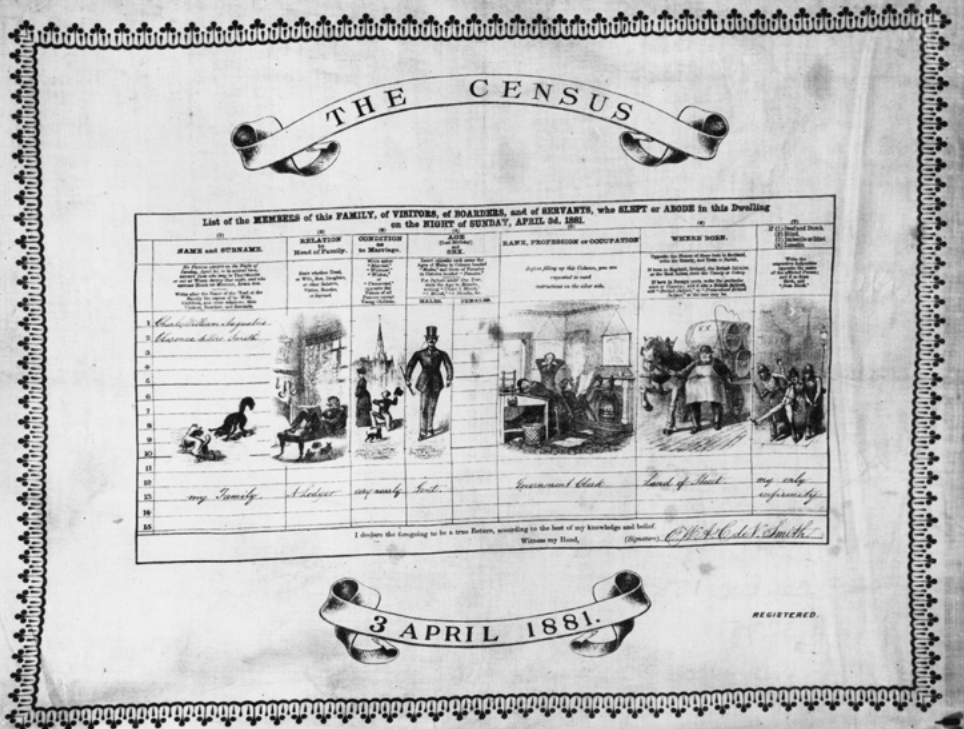
Between 1921 to 1931 new categories were added such as place of work, employer name, marital status and usual place of residence. 1951 onwards, the questionnaires included questions on educational qualifications and immigration status. The 1991 census further added categories such as presence of central heating, ethnic group and temporary address for students. The 21st century census now utilizes flexible methods and digital tools. By 2011, households could complete census forms online and it is possible that the 2021 census could be the last of its kind as the British government is exploring options to use other sources of data in future (Smith, 2021).

France and Canada
Another major European nation to start conducting a census was France. The first French population census took place in 1791, though regular town records generally date back to 1826 or 1831. Traditionally, censuses were held every five years, however France eventually moved to a decennial census. Since 2004, however, the French government has shifted to a rolling census method, which provides annual results at municipal levels and maintains a very low non-response rate (under 4%).
Canadian censuses also date as far back as 1851. The first census of the Dominion of Canada was conducted in 1871. The Census and Statistics Act of 1905 mandated a general census every 10 years starting in 1911. The regions of Newfoundland and Labrador were not part of the earlier federal Canadian census and conducted their own separate census in 1921, 1935 and 1945 (Narayan, 2023). These evolving census strategies and methods in the western colonial nations, were also employed and experimented with in respective colonies, including in India.
Comparisons between Indian and British early censuses
The British Empire at its peak (1910s-1930s), covered over 24% of earth’s total land area, comprising over 23% of the world population at that time. At different periods, the British empire did make an effort to conduct an empire-wide census exercise, as much as possible. First such efforts were made during the 1891 census and the General Register Office in London attempted to publish reports covering the whole empire in 1871 and in 1901, to present a unified statistical picture of British dominions across the globe. However, due to the sheer diversity of cultures, languages and the data it produced made it difficult to conduct empire wide synchronous census (Barrier, 1981).
The key difference between the early census in Britain and the census in British India was how it was conducted. The system in Britain relied on a higher degree of cooperation from the public. Due to the higher literacy rate, the heads of the households were given census schedules to fill it themselves. However, in British India, due to higher illiteracy, the state had to rely on the vast army of ‘agents’ such as village headmen, school teachers, religious leaders, government servants and paid enumerators to record and collect information (Waterfield, 1875).
In Britain, religion was only asked once (in 1851) on a voluntary basis and was subsequently avoided due to being too controversial for a representative government. In contrast, religion became a fundamental category in British India from the beginning. The British used this category to organize all the other data as well such as education and occupation. While Britain started using mechanical tabulators by 1911, use of such machines was largely deemed economically unfeasible in India and utilized a manual slip system for sorting the data for tabulation (Barrier, 1981).
The British officials and their agents faced cultural challenges in collecting and interpreting the accurate data on age. Unlike the western censuses, where age was a transparent record of longevity, the records of age in the Indian census were inaccurate due to the prevalence of innumeracy or the lack of concern for the precise age in the Indian society.
Most Indians did not know their exact age or year of birth, leading to massive spikes in data at multiples of five, which became statistically implausible.
To manage this chaos, British and Indian actuaries, G. F. Hardy, Thomas Ackland, and L. S. Vaidyanathan, developed ingenious technical innovations to smoothen the raw data. Their methods included Makeham’s Law, a mathematical formula to graduate doubtful returns, using well remembered natural disasters such as famines as baseline to correct reporting errors and shifting age ranges to account for the ‘misstatements’ regarding digits ending in 5 or 0. This disaster over age statistics became a battleground for political and social debate in the 1930s (Albron, 1999).
Britain shifted to requiring returns for every individual by name and occupation as early as 1841, however in India, due its much larger and diverse population, this shift came only in 1881 with the first synchronous census. In essence, while the British census was highly centralized, the Indian census suffered from inconsistency between its Provinces due to a high degree of decentralization. Compared with the other British colonies, the occupational data reflected a higher number of clerks from India while Australian and New Zealand colonies reported a higher proportion of teachers and nurses (Barrier, 1981).
Concluding remarks
It is important to re-emphasize that none of these early efforts and documentations produced any comprehensive demographic overview of India prior to the 1870s. Majority of these pre-colonial surveys were land centric as the states were mainly concerned with land revenue and resource consolidation. The modern idea of a comprehensive population census covering demographic characteristics only started emerging in the 17th–18th centuries.
There is a long held historical view that it was the British colonial government that invented the census and formed the modern socio-economic identities in India. However, historian Sumit Guha argues that long before the British started enumerations of Indians, pre-colonial Indian states were already keeping robust demographic records, using detailed population data to manage their kingdoms and empires, as demonstrated by the examples discussed above. Contrary to the myth that the British created Indian social categories out of thin air, they actually inherited the structure that was already in place, set by and composed of village level literate officials who had been counting and record-keeping for centuries. These same local experts became the primary enumerators for the colonial apparatus when the British first started conducting census. Guha and Peabody’s work reveals that Indian communities were never passive bystanders or recipients in this process, instead they were active participants in their own enumerations, using it as a strategy to navigate the state since, even before the British arrival, but especially during the British rule (Guha, 2003).
Some scholars have long argued that census in the 1870s were not entirely new and states have been counting people long before for the purpose of taxation and military recruitment. Although what changed after the 1870s was the transition towards systematic classification and quantification. These colonial censuses created uniform ‘grids’ that tried to categorize populations in standardized ways, going beyond mere administrative counts of the earlier times. Over time this categorization did more than recording the society, it also shaped it. Fluid and overlapping identities became fixed and rigid under the bureaucratic categories, as the state tried to define and understand the people it governed. The key exception was religion, which already had deep rooted identities independent of the colonial state (Anderson, 2006).
Crucially, as the modern census in western countries evolved from the 17th century onwards, the British gradually introduced them into the colonial censuses in India, even though they differed sharply from the British censuses in their home country. Finally, the first asynchronous census in 1872 marked the beginning of the regular decennial pan-India census that we have today. In the following series of articles under Censusnama, we dive deeper into the history of each decennial census from 1872 onwards.
(Authors: Gaurav Kalyani works as Research Associate at the Center for Legislative Education and Research, FLAME University, Pune;
Dr. Shivakumar Jolad works as Associate Professor (Public Policy), and is the Chair of Center for Legislative Education and Research and Director India State Stories, FLAME University, Pune
Gaurav contributed to conceptualization, research and primary writing; Shivakumar contributed to conceptualization, research and editing)
References
Ahom kings started census, land survey systems. (2010, September 15). The Assam Tribune.
Alborn, T. (1999). Age and Empire in Indian Census 1871-1931. The Journal of Interdisciplinary History, 30(1), 61–89.
Anderson, M. J. (2015). The American Census—A Social History (2nd ed.) [E-book]. Yale University Press. (Original work published 1988)
Anderson, B. R. O. (2006). Imagined communities: Reflections on the origin and spread of nationalism. Verso. (Original work published 1983)
Barrier, N. G. (Ed.). (1981). The Census in British India—New Perspectives. Manohar.
Census-taking in the ancient world. (2016, January 18). [Office of National Statistics UK]. https://www.ons.gov.uk/census/2011census/howourcensusworks/aboutcensuses/censushistory/censustakingintheancientworld
De Barros, A. C. (2020). Numerar e categorizar os vassalos d´el-Rei: O caso de Goa (1720-1835) [Masters Thesis]. NOVA University Lisbon.
Dyson, T. (2018). A Population History of India—From the First Modern People to the Present Day. Oxford University Press.
Guha, S. (2003). The Politics of Identity and Enumeration in India c. 1600–1990. Comparative Studies in Society and History, 45(1), 148–167.
History of Census in India. (2011). [Drop-In Article]. Census of India.
Karashima, N. (2010). Ancient to medieval: South Indian society in transition (2. impr). Oxford University Press.
Missiakoulis, S. (2010). Cecrops, King of Athens: The First (?) Recorded Population Census in History. International Statistical Review, 78(3), 413–418.
Narayan, M. K. (2023). A Treatise on Indian Census Since 1981. Census of India.
Parker, K., Horowitz, J. M., Morin, R., & Lopez, M. H. (2015). Race and Multiracial Americans in the U.S. Census In Multiracial In America. Pew Research Center.
Peabody, N. (2001). Cents, Sense, Census: Human Inventories in Late Precolonial and Early Colonial India. Comparative Studies in Society and History, 43(4), 819–850.
Shamasastry, R. (1931). Kautilya’s Arthasastra (4th ed.). Sri Raghuveer Printing Press.
Smith, S. (2021). The British Census. Shire Publications.
Waterfield, H. (1875). Memorandum on the Census of British India 1871-1872.


Comments