
4 | Treaties, Engagements, and Sanads: The Architecture of Relations between Indian Princely States and the British Raj
Updated: Aug 11
By Gaurav Kalyani
Published on: 7 May 2026
The relationship between the British Crown and the Princely States of India was one of the most complex political arrangements in modern imperial history. Unlike direct colonisation, it operated through a vast and varied body of legal instruments — Treaties, Engagements, and Sanads — each negotiated under different historical circumstances, each carrying its own weight of rights and obligations. Together, these documents formed the constitutional skeleton of what came to be called the system of Paramountcy. Understanding them is essential to understanding how British India was not one political entity but an intricate mosaic of sovereignty.
Treaties Engagements and Sanads
Before examining their content, it is worth clarifying what each term meant. To get an overview of the most important agreements that shaped the political geography and future of pre-colonial India, check the illustrated timeline on our British Annexation webpage.
Treaty - A treaty was a formal bilateral agreement between the East India Company (and later the British Crown) and a ruling chief or state, typically concluded at a moment of military or diplomatic intervention. These were solemn instruments, exchanged in duplicate, ratified by the Governor-General, and carried the weight of international-style compacts (Sastry, 1942).

Engagement - An engagement was a somewhat less formal but equally binding agreement, often extracted from smaller or less powerful chiefs, and frequently taking the form of pledges or security bonds. The famous Kael Zamins (security bonds) taken from Kathiawar chiefs by Colonel Walker in 1807 are a classic example of this, in which the chiefs bound themselves not to commit robberies or plundering incursions, and in return received guarantees of protection from the British Government (Sastry, 1942).
Sanad - A sanad (also spelled Sunnad in older documents) literally meant a deed or grant. It was a unilateral instrument issued by the British Government conferring rights, recognising succession, or defining the terms of a chief's political existence. The adoption Sanads issued by Lord Canning in 1862 to 160 states were among the most significant examples, which reassured the rulers that British doctrine of lapse would no longer be applied against them arbitrarily (Sastry, 1942).

These were the foundational legal instruments that defined, what Saksena (2023) calls ‘Divisible’ nature of sovereignty between the British Crown and the Princely States. These documents served as both tools of imperial expansion and, later, as the primary legal defense for princes seeking to preserve their autonomy. These legal texts provided the basis for the theory (championed by jurist Henry Maine) that sovereignty was not an indivisible unit but a ‘bundle of powers’ that could be separated (Saksena, 2023).
Maine’s theory allowed the British to treat princely states as both foreign territory (in some senses) and part of the empire (in others), softening the boundary between imperial and international law. British officials used this theory to build a system of precedent, where a decision regarding one state became a general rule for all, effectively expanding British authority at the expense of treaty rights (Saksena, 2023).
Illustrative Examples
To illustrate the essence and scope of these legal instruments, an example of each type is provided below.
Treaty of Bassein, 1802
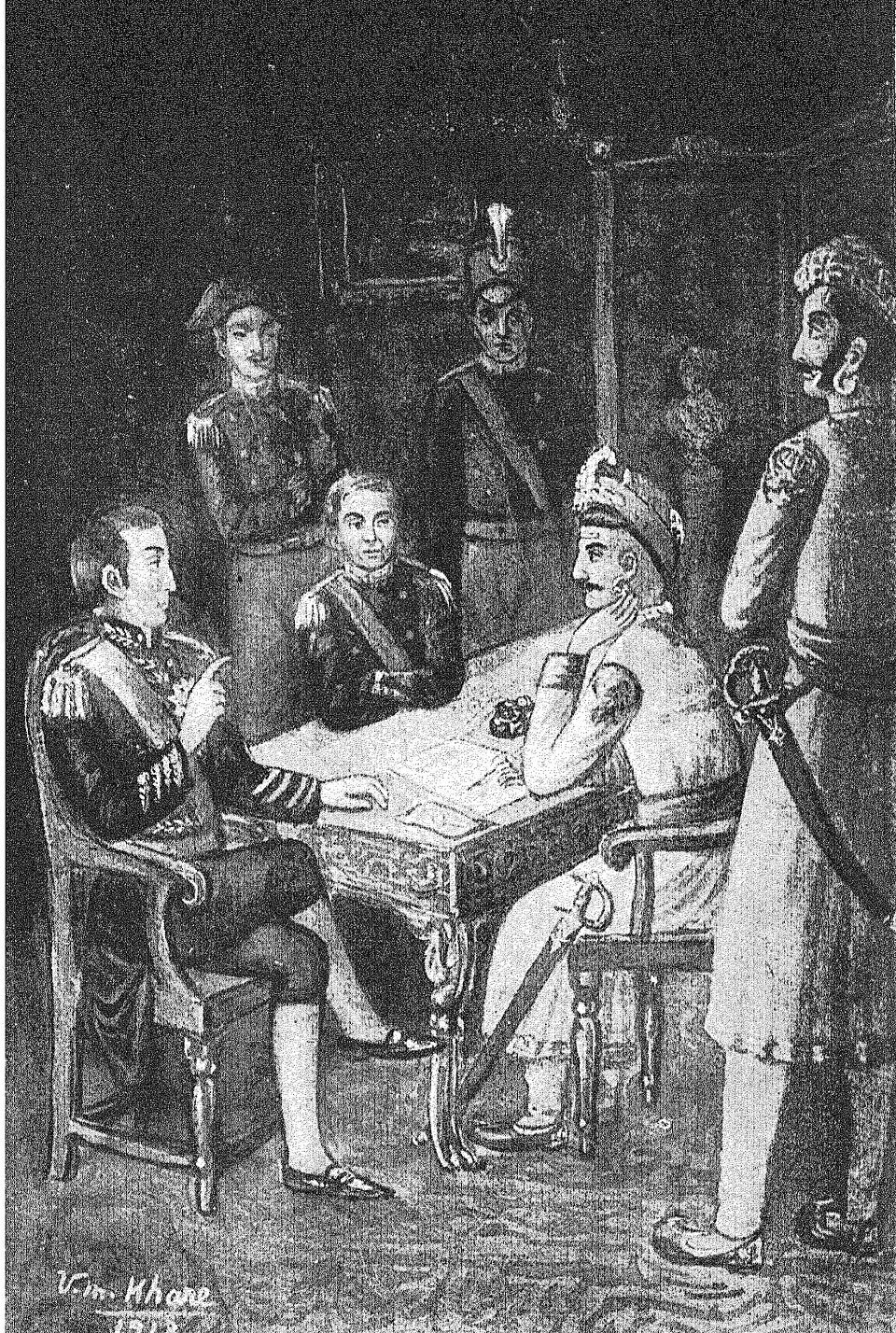
It was a defensive alliance between the British East India Company and the Peshwa Baji Rao II. After the first Anglo-Maratha war, the Peshwa ceded various territories in perpetuity, in exchange for a permanent subsidiary force of 6000 infantry. The ceded lands were required to yield the annual revenue of Rs. 26 lakhs for the maintenance of these force and as additional protection against revenue deficits.
The Peshwa was also to formally relinquish all rights and claims affecting Surat and in return the Company would deduct a district or piece of land of the similar value from the total ceded districts by Peshwa.
The treaty established that the "friends and enemies of either shall be the friends and enemies of both" The subsidiary force was designated for services such as protecting the Peshwa, overawing rebels, and correcting subjects who withheld just claims. In the event of war with another power, the Peshwa committed to joining his own troops (6,000 infantry and 10,000 horse) with the British subsidiary force to oppose the enemy.
The Peshwa engaged not to commence or pursue negotiations with any other power without giving previous notice and entering into mutual consultation with the Company. Under the terms, he also agreed to submit differences with other powers, such as the Nabob Asoph Jah Behauder (Nizam) or the Guicowar (Gaekwad), to the Company’s arbitration and to abide by their adjustment.
Original cessions included districts in the Province of Guzerat (Gujarat), territories south of the Taptee (Tapi) (such as Purnair and Balsur), and lands between the Taptee (Tapi) and Nerbudda. It also included 26 talooks in Savanore and lands from Bankapoor. All ceded territories and forts (which were to be delivered undamaged) were placed under the exclusive management and authority of the Company.
A supplement agreement in 1803 added further modifications. The British restored the country of Savenore, the talook of Buncapoor, and the pergunnah (Paragana) of Oolpah in Guzerat (Gujarat) back to the Peshwa. But in exchange for the restored lands, the Peshwa ceded territory in Bundelkhand province with a total value of Rs. 36,16,000.
The Peshwa’s military obligation during the war was reduced to 5,000 cavalry and 3,000 infantry. The British also agreed to maintain a corps of 5,000 Mahratta cavalry for the service of the Poona State.
Engagement on part of the Jodhpur Government regarding the Marwar lands in Mairwarra (Merwara), 1824

This Engagement between the Jodhpur Durbar and the British government outlines a series of diplomatic and administrative agreements. These agreements were focused on restoration of feudal chiefs, territorial management in Mairwarra (Merwara), and financial contributions for regional security.
One of the primary engagements from February 1824 concerned the restoration of estates to certain exiled Thakoors (chiefs). To please the British Government, the Maharajah of Jodhpur agreed to restore estates held during the time of Maharajah Bukht Sing within six months. The restoration was strictly conditional on the Thakoors' obedience.
If these chiefs were found guilty of offences or failed to conduct themselves, then the Maharajah retained the right to ‘act as he thinks proper’. The British Governor-General provided a khureeta (formal letter) assuring the Maharajah that once these chiefs were restored, the British would not again interfere on their behalf
A portion of the Engagement details transfer of Marwar lands in the Mairwarra (Merwara) tract to a British. Jodhpur Durbar agreed to maintain British forces, and committed to pay Rs. 15,000 annually for 8 years towards the expenses of these British Corps. Further, the villages of Chang Chitar and other Khalseh villages were made over in trust to the British for the stipulated eight-year period. The Durbar was permitted to keep an Agent for inspecting revenue accounts and any revenue collected by the British from these villages was to be deducted from the annual Rs. 15,000 contribution.
In October 1835, following the expiration of the original 1824 agreement, a new engagement was concluded to continue the arrangement. The Durbar engaged to continue the annual 15,000 Rupee payment and the trust of the Chang Chittar villages for an additional nine years. Furthermore, Jodhpur Durbar agreed to place seven additional villages into the trust under the same conditions. The engagement explicitly stated that at the conclusion of this new period, the annual financial contribution would cease, and all villages (both the original and the seven new ones) would be restored to the management of the Jodhpur Durbar.
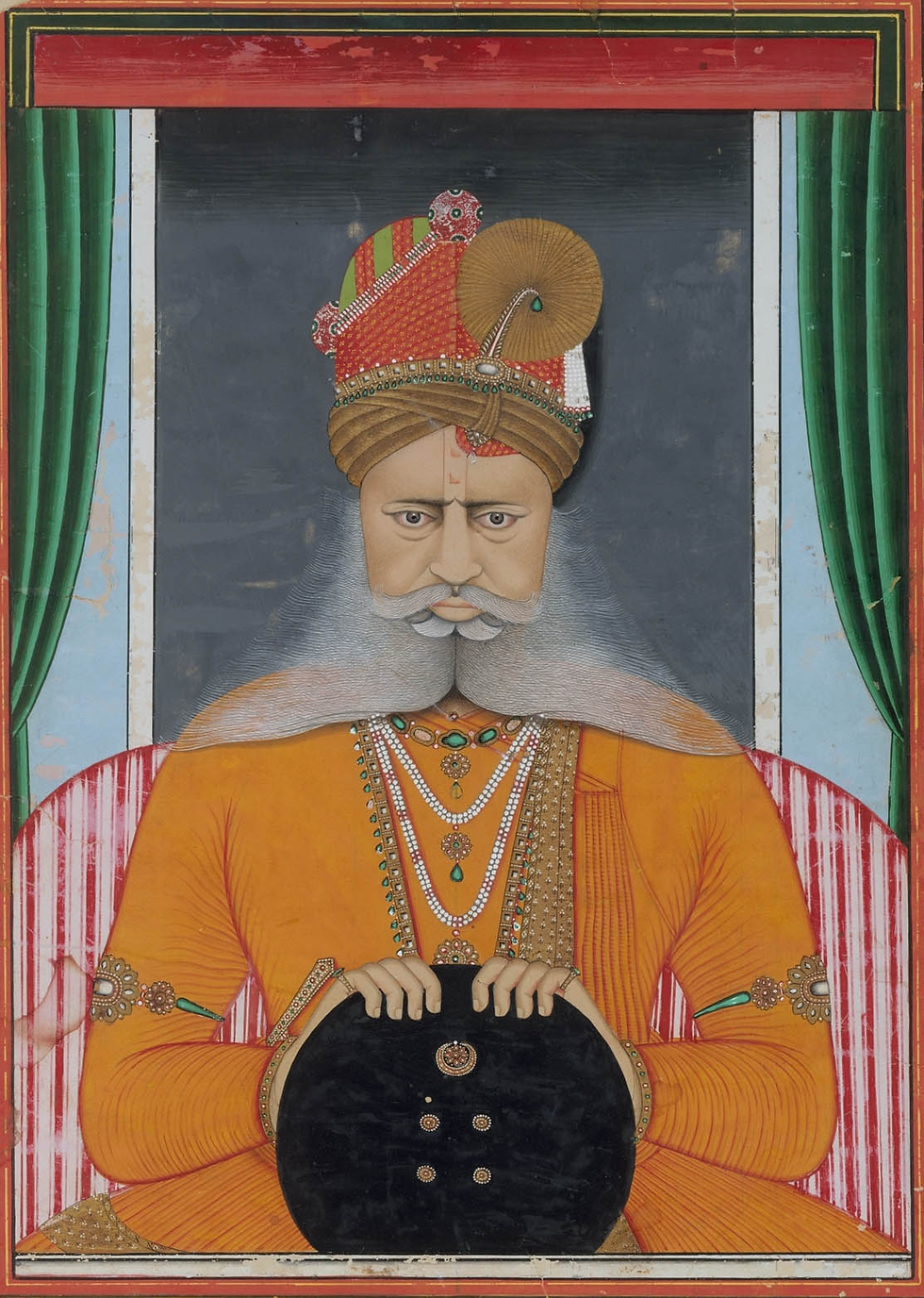
This Sanad formalizes the grant of territory to the Maharaja in recognition of his services during the 1857 rebellion. The Maharaja was honored for his "loyalty and devotion" during the rebellion, specifically for taking the field in person, spending his own funds, and protecting the lives of certain Europeans.
The British conferred a total of 41 villages situated in the district of Sirsa to the Maharaja in perpetuity. These lands were formally incorporated into his existing territory effective May 1, 1861. The granted villages yielded an initial total annual revenue (Jumma) of 14,291 Rupees.
Several villages were granted with a ‘progressive jumma’, meaning the revenue demand was scheduled to increase over time. There were:
Kara Khara: Rose from 490 Rupees in 1861-62 to 590 Rupees in 1865-66.
Kishenpoora: Scheduled to rise to 300 Rupees by 1870-71.
Rathee Khara: Started at a nominal 16 Rupees, rising to 235 Rupees by 1865-66
The full texts of these legal instruments, extracted from A Collection of Treaties, Engagements and Sanads Volume 2 and 3 by C. U. Aitchison can be read in the appendix provided below.
The Historical Arc: From Alliance to Paramountcy
The evolution of these instruments broadly followed the trajectory of British political power in India. K.R.R. Sastry (1942), identifies 1813 as a critical dividing line. Treaties before that date were largely concluded between parties who, at least formally, treated each other as allies. After 1813, the language shifted, along with the underlying power dynamics.
In the earliest phase, the East India Company entered into commercial and defensive alliances with major powers as relative equals. The Treaty of 1766 with the Nizam described their relationship as one of "perpetual honour, favour, alliance, and attachment." The treaty with Travancore of 1795 was premised on two sovereign states offering each other mutual defence (Sastry, 1942).
The Gaekwar of Baroda and the Company concluded arrangements in 1802 on the basis of "true friendship and good understanding." This language was not merely diplomatic courtesy, it reflected a genuine, if unequal, political reality in which the Company needed these states as much as they needed the Company (Sastry, 1942).
The watershed came with Lord Hastings' period as Governor-General (1813–1823), during which the suppression of the Pindaris and Marathas gave Britain decisive military supremacy. The treaties concluded in the 1818 with Rajputana states of Udaipur, Jodhpur, Jaipur, Bikaner, Bundi, and others, introduced a new formula: the ruler was to "act in subordinate co-operation with the British Government and acknowledge its supremacy." The phrase was formulaic but consequential. Internal sovereignty was retained on paper, but external affairs, diplomatic intercourse, and military policy were now managed by the British and remained ambiguous (Sastry, 1942).
The Classification of Agreements
The body of instruments can be grouped into categories, each serving a distinct political or administrative purpose.
Category | Primary Purpose | Key Examples |
Treaties of Amity & Defensive Alliance | Establish foundational political relationship | Hyderabad (1800), Travancore (1805), Rajputana States (1818) |
Territorial Exchange & Cession Agreements | Transfer or grant of land | Treaty of Amritsar (1846), Jhalawar Sanad (1899) |
Adoption Sanads | Recognition of succession rights | Canning's Sanads (1862), Lansdowne's Sanads (1890) |
Extradition Treaties | Surrender of criminal fugitives | Hyderabad (1867), Alwar and Rajputana States (1867–1870) |
Railway Jurisdiction Agreements | Cede civil/criminal jurisdiction over railway lands | Baroda (1879), Holkar (1864), Cochin & Travancore (1899) |
Salt & Opium Agreements | Control over revenue-generating commodities | Sambhar Lake Treaties (1869–70), Kathiawar Salt Agreements (1883) |
Port Conventions | Customs, port dues, and trade regulation | Inter-Portal Convention (1865), Bhavnagar Agreements (1860, 1866) |
Imperial Service Troops Agreements | Organise state forces for imperial use | Alwar, Jaipur, Kashmir, Punjab States (1898–1901) |
Minority Rules & Regency Arrangements | Govern state administration during ruler's minority | Government of India Resolution (1917) |
(Source: Sastry, 1942)
The Territorial Clauses
One of the most striking features of the foundational treaties was their categorical assurance of internal sovereignty. Nearly every major treaty of the 1818 period contained some version of the same clause. The Treaty with Jodhpur stated that "the Maharajah and his heirs and successors shall remain absolute rulers of their own country and the jurisdiction of the British Government shall not be introduced into that principality." Identical or near-identical language appears in treaties with Udaipur, Bikaner, Bhopal, Jaipur, and Bundi (Sastry, 1942, Saksena, 2023).
Far from being a hollow formula at the time of their writing, they reflected a genuine political bargain: the chiefs surrendered external sovereignty in exchange for a guarantee of internal autonomy and military protection. The Treaty with Orchha (1812) went so far as to guarantee that the British Government would "protect and defend the dominions at present in Rajah Bahadur's possessions from any foreign power." The Treaty with Indore (1818) pledged that "the British Government will at all times extend the same protection to the territories of Maharajah Holkar as to his own” (Sastry, 1942).
However, as the nineteenth century advanced, these guarantees were quietly eroded. Salt agreements extracted from states like Cutch and Patiala during minority regimes surrendered sovereign rights over salt manufacturing without the ward's meaningful consent. Railway jurisdiction agreements progressively transferred civil and criminal authority over railway lands to British officers (Sastry, 1942, Saksena, 2023).
The residency bazaars of Hyderabad and Indore expanded far beyond the diplomatic enclaves they were meant to be, creating quasi-British commercial zones inside state territories, creating a situation so anomalous that they were eventually retroceded to the states only in 1933 (Sastry, 1942, Saksena, 2023).

The Sanad System
Among the most legally contentious instruments were the Sanads — particularly those issued to smaller states like the Orissa tributaries. The Orissa states received successive Sanads in 1862, 1874, 1894, 1908, 1915, and 1937, each iteration increasing the British supervision of internal administration. By the Sanad of 1915, the ruler was required to "conform in all matters concerning the preservation of law and order, and the administration of justice generally, within the limits of his State, to the instructions issued from time to time" by the Lieutenant-Governor (Sastry, 1942).
Mayurbhanj, one of the more historically significant Orissa states, consistently protested these encroachments, arguing that they contradicted its Treaty of 1829, which had imposed no restrictions on internal sovereignty (Sastry, 1942).
The legal advice obtained by Maharaja Surain Chandra Bhanj Deo from the Advocate-General of Bengal confirmed that the Sanads "derogated from his rights as the Ruler of a Tributary State." Yet these protests went unheeded. This pattern of solemn treaty on one hand, and incrementally intrusive Sanads on the other, exemplified the gap between the colonial law in letter and its administrative practice (Sastry, 1942).
Railway and Commercial Agreements
The railway agreements of the latter half of the nineteenth century represent one of the subtler mechanisms through which British jurisdiction was extended into state territory. The initial agreements, such as Baroda's correspondence of 1856 and the Holkar Memorandum of 1864, ceded jurisdiction over railway lands in relatively limited terms (Sastry, 1942).
However, following the Privy Council's ruling in Muhammad Yusuf-ud-Din v. Queen Empress (1897), which held that jurisdiction over Nizam's railway lands did not extend to arrests made outside the immediate railway corridor, the British Government revised its standard formula to demand ‘full and exclusive power and jurisdiction of every kind’. This change appeared in agreements with Cochin, Travancore, Gwalior, Panna, Rampur, and Patiala after 1899 (Sastry, 1942).
In the case of Patiala, the state offered objections to the revised formula, but the Resident's response was blunt. ‘Imperial reasons’ were given which required compliance, and the instruction was issued that "the Patiala Durbar should comply with the wishes of the Government in the matter." This was the exercise of paramountcy in its rawest form. It was more of an administrative command backed by political power rather than a legal argument (Sastry, 1942).
The Doctrine of Paramountcy and Its Implications
By the early twentieth century, paramountcy had evolved from a political fact into a quasi-legal doctrine, though one that resisted precise definition. Sir W. Lee Warner described it as a power "of which the extent is wisely left undefined." The Indian States Committee (Butler Committee, 1929) held that "paramountcy must remain paramount; it must fulfil its obligations defining or adapting itself according to the shifting necessities of the time." This suggests that it wasn’t just a juristic definition but a political assertion (Sastry, 1942).
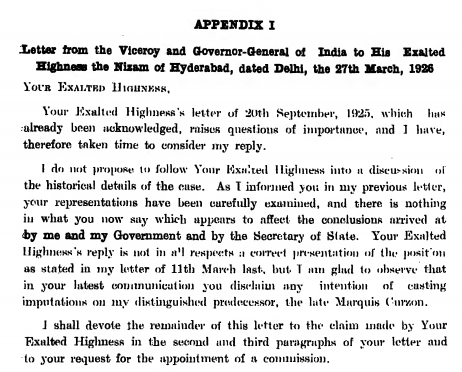
Lord Reading's letter to the Nizam of Hyderabad (1926), written in the context of the long-running Berar dispute, articulated paramountcy most starkly: "no ruler of an Indian State can justifiably claim to negotiate with the British Government on an equal footing." This was a far cry from the treaties of 1766 that spoke of "perpetual honour, favour, alliance, and attachment" between states. This transformation had taken one and a half centuries, but it was remarkably thorough (White Paper, 1950).
Interpretations and Discontents
These instruments generated a rich body of interpretive disputes. The Bundi Treaty of 1818 was found to have been concluded in partial ignorance of actual territorial arrangements, requiring subsequent financial compensation to Holkar. The Gwalior Treaty of 1803 generated a famous controversy over whether Article IX encompassed the fortress of Gwalior and the Pargana of Gohad. Arthur Wellesley himself acknowledged this dispute, quoting that he had ‘negotiated the treaty in ignorance’ of relevant prior engagements (Sastry, 1942).
The Bhavnagar Agreements of 1860 and 1866, which promised Bhavnagar the full benefits of a British port, became the subject of sustained disagreement when the Viramgam customs line was imposed in the twentieth century. This dispute was eventually settled by arbitration in 1934 (Sastry, 1942).
In each of these cases, the British administration tended toward a reading that favoured administrative convenience. Sir W. Lee Warner articulated this interpretive principle most candidly, stating treaties and grants "must be read as a whole, like the decisions of English Courts of Justice, so that the principles most recently laid down are to be applied to all." In practice, this meant that a restrictive precedent set against one state could be generalised across the entire system. This approach privileged administrative uniformity over the particular historical circumstances in which each treaty had been negotiated (Sastry, 1942, Saksena, 2023).
The most potent use of treaties was the establishment of the Subsidiary Alliance system. These treaties were used to define the relationship between the Paramount Power and roughly 45 major subsidiary states. While the terms varied, the treaties typically enforced three common commitments: the state's relinquishment of the right to self-defence, the relinquishment of independent diplomatic relations, and the requirement to submit all inter-state disputes to British arbitration (Singh, 2020).
In exchange for British military protection, these treaties forced states to either cede vast territories or pay annual subsidies. The British used these texts to define native states as semi-sovereign or protected dependent states, creating a normative scarcity for Indian rulers (Singh, 2020).
Another major contention was the tension between the literal lines of text of these documents and the evolving political practice of the British government. By the 1920s, princes and their advisors (like Leslie Scott and K. M. Panikkar) insisted that the British Crown possessed no rights over a state except those explicitly ceded through treaties, engagements, or sanads, further asserting that ‘residuary jurisdiction’ remained with the state (Saksena, 2023).
Conversely, British officials and the Indian States Committee (1929) argued that the relationship was not merely contractual but was a ‘living, growing relationship’ shaped by policy and usage, claiming that ‘usage’ could override specific clauses based on changing conditions and imperial interests (Saksena, 2023).
At the time of independence, the princes also used these documents to argue that their relationship was directly with the British Crown and not with the government of British India. They claimed that because their treaties were with the Crown, their sovereign rights could not be transferred to a future independent or responsible Indian government without their explicit consent.
Conclusion
The treaties, engagements, and Sanads of British India constitute one of history's most elaborate systems of graduated sovereignty. They ranged from the quasi-international compacts concluded with Hyderabad, Gwalior, and Kashmir - states that had never been conquered and whose treaties were negotiated in genuine recognition of their power, to the unilateral instruments imposed on petty Orissa states that had little say in their own administrative fate.
What is remarkable is that this vast legal architecture was never systematically codified or unified. Each instrument stood separately, negotiated in its own historical moment, carrying its own specific provisions. The system worked as long as the Paramount Power exercised restraint and it strained badly when it did not. The exploitation of minority regimes for salt and coinage concessions, the extension of railway jurisdiction far beyond what states had consciously agreed to, and the expansion of residency bazaars, were not just violations of the letter of these treaties, but their slow unravelling (Sastry, 1942, Saksena, 2023).
The Royal Proclamations of 1858, 1903, 1911, 1919, and 1921, which repeatedly reaffirmed British commitment to the "rights, dignities, and privileges" of the ruling princes, served both as genuine assurances and as moral anchors against the most aggressive extensions of paramountcy. They did not, however, substitute for a clear juristic framework. As Sastry (1942) concluded, the status that emerged from this entire corpus was ultimately quasi-international i.e. neither fully sovereign nor fully subject, neither international nor purely municipal.
In the final years of British rule, the role of these treaties shifted again. The British government ultimately decided that it could not transfer the obligations of paramountcy to a successor government. To break these ties, the British relied on the international law doctrine of rebus sic stantibus (fundamental change of circumstances) to unilaterally terminate the treaties, claiming that the withdrawal from India made it impossible to fulfill defense and protection obligations. Better known as the ‘Lapse of Paramountcy’, this technically and theoretically returned all surrendered rights and sovereignty to the respective princely states, in practice it left them vulnerable and with little choice than integrating with the new Dominions of India or Pakistan (Saksena, 2023).
Sources:
Sastry, K. R. R. (1942). Treaties, Engagements and Sanads of Indian States—A Contribution in Indian Jurisprudence. Allahabad Law Journal Press.
Saksena, P. (2023). Sovereignty, International Law, and the Princely States of Colonial South Asia. Oxford University Press.
Singh, P. (2020). Indian Princely States and the 19th-century Transformation of the Law of Nations. Journal of International Dispute Settlement. Vol.2 (3), pp. 365-387. https://doi.org/10.1093/jnlids/idaa012
White Paper on Indian States. (1950). Ministry of States, Government of India. https://en.wikisource.org/wiki/White_Paper_on_Indian_States_(1950)
Appendix
Treaty of Bassein 1802
Engagement with Jodhpur, 1824
Sanad granted to Maharaja Sirdar Singh Bahadoor of Bikaner, 1861


Comments