
28 | How India Made Its Living: Occupation in the Census of India, 1921
By Gaurav Kalyani
Published on 7 August 2026
Introduction
The occupation chapter of the 1921 Census of India set out to answer a simple question: how did the people of India earn their living? Marten, the census commissioner, concedes that this was among the hardest tasks the census attempted. Occupational statistics, it notes, are “perhaps the most valuable of all those obtained at a periodical census,” yet also “undoubtedly the most difficult to collect with accuracy and to compile with precision.”
The census enumerated occupation through three schedule columns: the primary occupation of workers, any secondary occupation, and the means of subsistence of dependents who did not themselves work. The distinction between “worker” and “dependant” was central, which was introduced in 1901 and maintained since. A worker included not only those who laboured but “those who live on rent or on income from investments or on pensions.” While Dependants were defined as “the women, children and the old and infirm, who rely on others for their support.”
This essay draws on the general distribution tables, the accompanying industrial census, and the observations of provincial superintendents to trace the evolving occupational structure of India in 1921. It was an economy still overwhelmingly agricultural, with a modest but growing industrial sector, a large and mostly informal trading population, and a small class of administrators and professionals.
Counting a Continent's Occupations
Similar to the previous census, the classification scheme used in 1921 adapted a system devised by Dr Jacques Bertillon and approved by the International Statistical Institute, sorting the population into four classes, twelve sub-classes, fifty-six orders and 191 groups.
Table 1. The occupational classification, 1921
Class | Sub-classes |
A. Production of raw materials | I. Exploitation of animals and vegetation (agriculture, pasture); II. Exploitation of minerals |
B. Preparation & supply of material substances | III. Industry; IV. Transport; V. Trade |
C. Public administration & liberal arts | VI. Public force; VII. Public administration; VIII. Professions & liberal arts; IX. Persons living on their income |
D. Miscellaneous | X. Domestic service; XI. Insufficiently described occupations; XII. Unproductive |
Earlier schemes had proved unworkable: the 1891 classification swelled to 478 groups by 1901, and experience showed that “attempts at elaborate classification were beyond the capacity of the Indian returns and the results were incommensurate with the cost and labour spent on them.” The 1921 scheme therefore aimed at workable simplicity rather than exhaustive precision.
Three principles guided the classifiers. Where a person both made and sold goods, they were classed under industry rather than trade, which was reserved for those dealing in goods they had not produced. Industrial and trading occupations were divided by material or by finished use, with artisans such as the village cobbler classed by material since he might make shoes, waterbags and other leather goods indiscriminately. And an occupation was generally classed by the specialised training it required rather than by the employer, for eg. a doctor on a ship was recorded as a doctor, not as a ship's officer.
Enumerators struggled with the subtleties of interpretation separating worker from dependant and principal from subsidiary occupation. The most unsettling inaccuracy was the return of vague general terms like labourer, clerk, business, shopkeeper, that defied exact classification. However, a decrease in such entries was noted compared with 1911, but the problem was not eliminated.
Records of Secondary occupations were considered particularly unreliable. One provincial superintendent, Mr. Sedgwick of Bombay, considered the present figures so entirely untrustworthy that he decided to abandon the tables altogether. Secondary-occupation figures were consequently not compiled for all-India comparison. This candour about the data's limits is itself a useful guide to reading the statistics.
The General Distribution of Occupations
At the broadest level, the 1921 census divided the population into four classes: the production of raw materials, the preparation and supply of material substances, public administration and the liberal arts, and a residual miscellaneous class. The shares of the total population supported by each class are set out below.

The dominance of the class A is unmistakable. Agriculture and pasture alone supported 224 million people, or 71 percent of the population of British India and the States combined; adding pastoral and hunting occupations brings the figure to 73 percent. Organised industry, in the narrow sense of factories and workshops rather than village crafts, occupied only about 1 percent of the population.
Marten was direct about the implication, stating that “India is essentially an agricultural country.” Industries as a whole, including the large number of unorganised cottage trades, supported just over 10 percent. Trade supported a further 5.7 percent, transport 1.4 percent, and public administration and the liberal arts together only 3.1 percent.
It illustrates how small the administrative apparatus of British India was relative to the population it governed. The remaining 6 percent fell into the miscellaneous class, dominated by domestic service and the large, unsatisfactory category of “insufficiently described occupations,” discussed below.
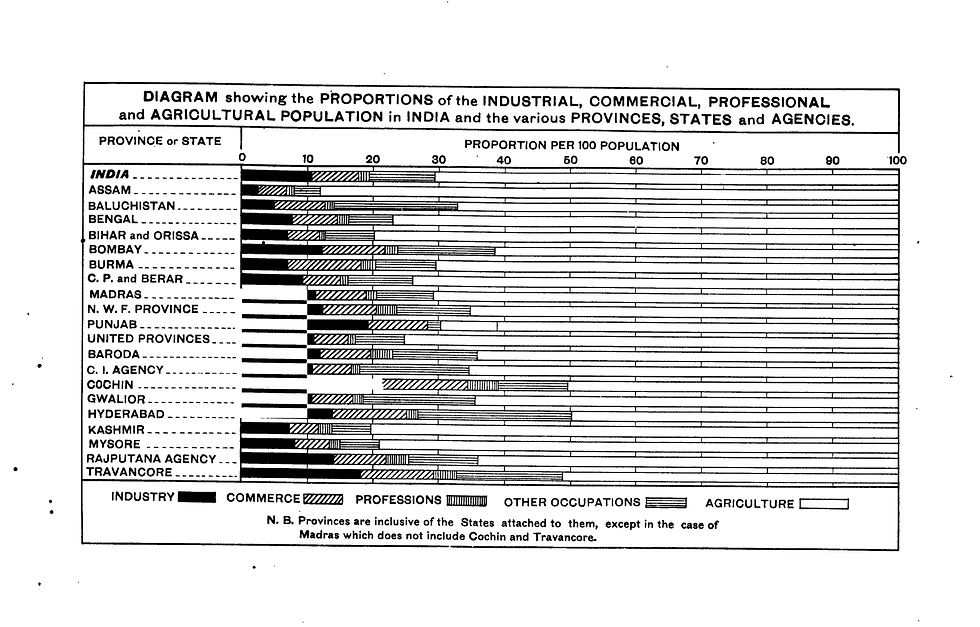
Comparing provinces, agriculture predominates everywhere, though its share varies. Bengal and Bihar and Orissa were found to be overwhelmingly agricultural, containing a higher proportion of persons supported by this occupation than any other tract of India. Industrial workers were proportionately most numerous in the Punjab, the United Provinces and Bombay, though in the first two this largely reflected cottage industry; only in Bombay had organised industry become of real economic importance, and even there it remained concentrated in a handful of large cities.
Workers and Dependants
One of the more stable findings across successive censuses concerns the ratio of workers to dependants in the population. The proportion changed only slightly between 1901 and 1921, moving from 47:53 to 46:54.

The distinction between worker and dependant was treated with some caution, noting that it depended heavily on local convention about “the relative dignity of work and dependence held by the enumerator or the public.”
The Provincial Superintendent for the Punjab observed that a large part of the apparent want of employment of female labour arose because the classification of occupations had been drawn up by men and not by women, so that many women who were engaged in domestic duties like, cooking, grinding grain and fetching water were recorded as unemployed dependants rather than as workers. It was treated as a genuine limitation of the schedule rather than a fact about women's economic contribution.
Change Since the 1911 Census
Comparison with the previous census reveals a mixed pattern of growth and contraction across the different occupational sub-classes. Some of the shifts reflect genuine economic change; others, the report cautions, are better explained by changes in enumeration practice or classification than by any real movement of population between occupations.

The most striking single figure is the 20 percent increase in the “insufficiently described occupations” category, where people whose returns were too vague, such as unspecified labourers and clerks. This is treated in the report not as evidence of a real change in the workforce but as evidence of enumeration difficulty.
It is set against a genuine improvement elsewhere: the number of vague general terms had, in fact, decreased in some provinces compared with 1911, even as this residual category grew nationally. This was a discrepancy the report did not fully resolve.
Transport recorded the largest proportional decline, at nearly 14 percent, while public force fell by 9 percent and independent incomes by 11 percent. Industry as a whole declined by 6 percent, a fall the report attributes chiefly to reduced numbers in food processing, building and textile trades rather than to any general industrial contraction. Indeed, as later sections show, several individual organised industries expanded briskly over the same decade. Agriculture, mining and trade all posted modest gains, consistent with a population that had grown only slightly (from about 313 million in 1911 to 316 million in 1921) and had not shifted its basic economic structure.
Agriculture: The Economic Base

Given that agriculture supported nearly three-quarters of the population, a substantial attention was devoted to its internal structure: the distinction between landlords living on rent, ordinary cultivators, and field labourers, along with the very uneven ratio of land to labour across provinces.
The report was direct about rural poverty in parts of eastern India. Discussing Bengal, it compared the acreage available per agricultural worker with figures from England and South Africa. In Bengal, the calculation from the Agricultural Statistics of 1919-20 yields only 2.215 acres of cultivated land per worker. In England and Wales, by the 1911 census, the figure was about 21 acres per worker — ten times as much. In South Africa, even after allowing for the more extensive style of farming there, cultivated land per worker came to 83 acres, some 38 times the Bengal figure.
Mr. Thompson, the Census Superintendent of Bengal, stated that this was the root cause of poverty. Thompson's explanation was that Bengal's minutely subdivided holdings left cultivators with land too small to occupy them fully through the year, while custom and tenancy law discouraged other work to fill the gap.
“The cultivator works fairly hard for a few days in the year when he ploughs his land and puts down his crops and again when he harvests them, but for most of the year he has little or nothing to do,”
he observed, concluding that the problem was less a shortage of land than an inefficient distribution of the available work across the year.
The report also documented wide regional variation in the ratio of landlords to cultivators. Bengal's landlord class, including intermediate rent-receivers below the great zamindars, was estimated to earn on average only about Rs. 620 a year per family, complicating any simple picture of a landlord class living comfortably off rent.
Cottage Crafts and Organised Manufacture
Industry, in the sense of manufacturing and processing occupations, supported about 10.5 percent of the population, but the census draws a sharp distinction between the vast unorganised sector of village and cottage industry and the much smaller organised sector captured by the special industrial schedule.
That schedule, sent to establishments employing ten or more people on separate enumeration, returned a total of 2.68 million persons employed in 15,606 establishments across India. It was a small fraction of the 33 million supported by industry as a whole, but the part of the industrial economy for which the most reliable statistics exist.
Textiles, Coal and Metal Working
Textiles were, by far, the most important of the industries, and within textiles, cotton and jute dominated. Cotton-connected occupations supported 5.87 million persons, about three-quarters of the whole textile category, concentrated heavily in the Bombay Presidency, which accounted for 64 percent of personnel employed in registered cotton establishments. The number of Bombay cotton mills grew from 497 to 566 over the decade, and their workforce from 198,169 to 277,857.
Jute, by contrast, was almost entirely confined to Bengal, where 62 mills, 56 employing more than 400 workers each, clustered along the Hooghly. Employment grew 42 percent over the decade even as the number of concerns rose by only 12, reflecting the expansion of existing mills. Ownership remained ‘almost entirely controlled by Europeans,’ with every jute mill having a European manager. By contrast, the cotton industry particularly remained in the hands of Indians.
The coal industry, concentrated in Bihar and Orissa and Bengal, supported 288,000 people, of whom about 205,000 were actual workers. The Jherria coalfield in Manbhum alone produced over half of India's annual coal output.
The report devoted real attention to the difficulty of retaining a stable colliery workforce, quoting the observation that “the coal miner is an agriculturist who only turns to coal mining when force of circumstances drives him to seek some means of subsistence other than the fields.” A 1917 committee found only about 15 percent of Jherria labourers had genuinely settled at the mines, the rest drifting in and out for weeks or months at a time.
Iron and steel manufacture was described through the Tata Iron and Steel Company's works at Jamshedpur, which formed the greater part of the town. The account described a stratified workforce: European and American smelters earning from Rs. 300 upward, followed by skilled Indian rollers and moulders drawn from castes such as Kamars, Brahmans and Rajputs, and lastly thousands of unskilled labourers, including women employed in brick-moulding, drawn chiefly from the Chota Nagpur plateau.
Organised Industries Ranked by Employment
The census also ranked individual organised industries by persons employed, illustrated in the chapter by a diagram of concerns employing 10,000 or more workers. The two largest categories by far were tea plantations and cotton spinning and weaving mills, each employing several hundred thousand workers. Jute mills and collieries followed at a distance, with railway workshops, cotton ginning and pressing, and metal and engineering workshops making up the remainder of the largest concerns.
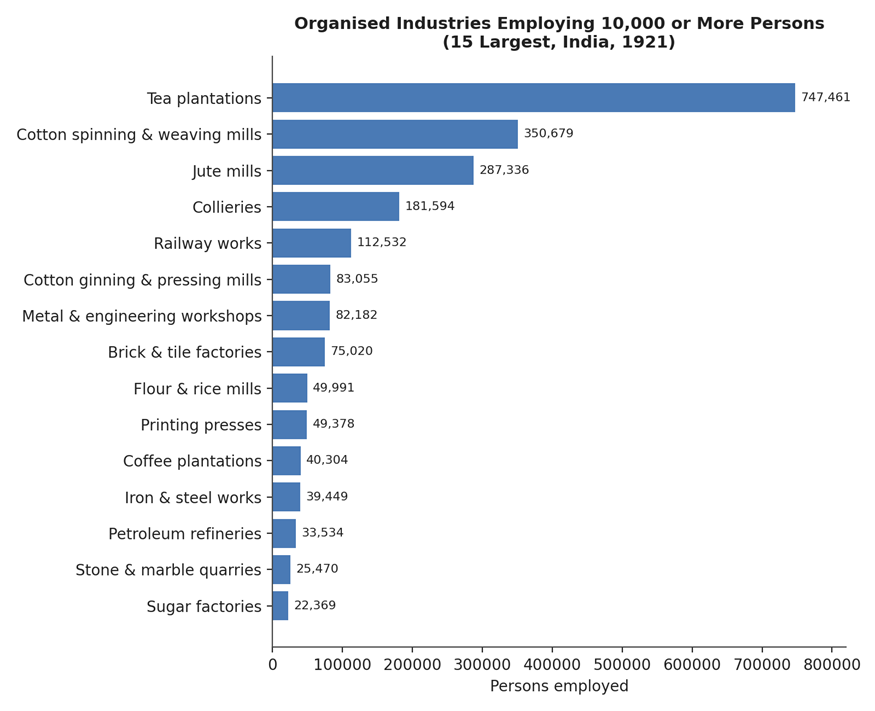
The drop-off after the first few entries was steep: tea plantations alone employed more than double the workforce of the cotton mills, and more than the next four industries combined, which reflected the plantation system's labour intensity, since tea cultivation and processing required large resident workforces on individual estates.
The Industrial Census
Alongside the general population schedule, the 1921 census carried out a special industrial enquiry, extending an experiment first attempted in 1911. Establishments employing ten or more people on separate remuneration completed detailed returns covering ownership, management, workforce composition, and power used, and this schedule was the source of most of the detail on organised industry discussed above.
Of the 2.68 million industrial workers captured by this enquiry, skilled workmen formed about a quarter, and unskilled labourers about three-quarters, of the total. Only 51 percent of establishments used mechanical power of any kind, steam remaining the dominant source.
Ownership was overwhelmingly private: of 15,606 establishments enumerated, only 677 were government-owned and 3,292 owned by registered companies, and the rest were in private hands. Although tea gardens and jute mills were predominantly company-owned, cotton ginning and rice milling remained largely private.
Fewer than a quarter of the 14,863 managers recorded were Europeans or Anglo-Indians, and European management remained the norm in tea, coffee and rubber plantations and in Bengal's jute mills. By contrast, Bombay's cotton mills, with a far larger workforce, employed European or Anglo-Indian managers in only about one-tenth of cases.
Trade and Rural Markets
Trade supported 18.1 million people in 1921, a modest 2 percent increase in 1911. More than half of this population depended on food-related trades. Dealers in grain, pulses, vegetables, condiments and similar produce together accounted for well over 5 million people, with grocers and sellers of vegetable oils, salt and condiments forming the largest single group.
The census report gave unusual attention to the structure of rural trade. The picture that emerged was of a system built around periodic markets, as opposed to fixed shops. In rural Bengal, permanent shops were rare. One could travel miles along main roads through some of the most thickly populated parts of the country and see none, with trade instead concentrated in twice-weekly haats. They were described as “as much a place of recreation as a place of trade.”
A similar pattern is recorded for Assam, Bihar and Orissa, the Central Provinces and Madras, each with its own account of periodic bazaars and intermediaries such as the Bepari and Goladar of Bihar and Orissa, who bought grain at the threshing floor and passed it up a chain of dealers toward the export trade. Rural trading organisation in Madras was described as primitive, with a customer who “cannot dictate what he will buy, but has to choose from very limited and arbitrarily selected alternatives.”
Public Administration, the Liberal Arts, and the Professions
Public administration and the liberal arts together supported 9.8 million people, or 3.1 percent of the population, a modest figure reflecting the small scale of the colonial administrative apparatus relative to the population governed. The army recorded the largest increase since 1911, up nearly 14 percent, linked to wartime recruitment. Police numbers, by contrast, fell. Instruction with teachers and educational administration, rose by 19 percent, with growth concentrated in the Indian States, where numbers connected with education more than doubled in Hyderabad State.
The legal and medical professions grew modestly, while numbers connected with religion, journalism and the performing arts declined. The decline in musicians and actors, from 689,000 to 496,000 including dependants, was attributed to restrictions in amusement in a year of economic scarcity rather than to any structural shift. It is a good reminder that a single census year can capture short-term conditions as much as long-run trends.
The Occupations of Women
The occupation chapter devoted a separate section to female occupation, and it was candid about the limitations of the data. The overall ratio of 455 female workers per 1,000 male workers is described as giving “an entirely inaccurate impression of any social or economic truth.”
It was because the schedule made no distinction between a woman devoting her entire working time to an occupation and one giving it only occasional attention alongside household duties. The Census Superintendent for Burma illustrated the problem with reference to weaving: women in many households wove only in odd moments between domestic tasks, so recording them as equivalent to full-time male weavers produced misleading comparisons.
A parallel attempt to record full-time “housewives” as a distinct category in Burma was abandoned when the figures proved too unreliable.
Despite these caveats, the recorded figures do show clear patterns of concentration. Women outnumbered men, proportionally, in spinning, in food-processing trades such as rice-pounding and grinding, and in domestic and personal service. The illustration below compares women's participation, as workers per 1,000 male workers, across several occupations in 1911 and 1921.


The decline in the overall proportion of female workers was attributed chiefly to a shortage of young adult women in the population rather than any withdrawal from the workforce. The Punjab Superintendent argued that the exclusion of women from productive work outside domestic tasks in his province represented “a vast waste of female labour,” contrasting this with a reliance on female labour that, in his view, no European country's standard of living could be maintained without.
The Character of Labour
A dedicated section of the chapter addresses ‘labour’ as a distinct category: persons in casual or unskilled work rather than an established craft or trade. Including all categories with a substantial labouring component, the report estimates roughly 12 million persons depended on labour of this kind, concentrated particularly in the central and southern parts of the country, which supplied both the tea plantations and mining industries of the east and the more technical industries of the western cities.
Provincial accounts describe a recruitment system built substantially on cash advances paid before labourers left their home villages. In the Central Provinces, Mr Roughton observed that this advance system, though the only practical means of recruiting labour from a distance, left the labourer with “a load of debt to the avoidance of which he devotes much ingenuity,” and that raising wages without the customary advance often reduced rather than increased the work obtained, since labourers with sufficient income for immediate needs worked fewer days.
The United Provinces report compares Indian and English labour conditions directly. Citing the proportion of the workforce classified as labourers in England and Wales against the far lower equivalent figure for the United Provinces, Mr Edye concluded that Indian agricultural labour was, in relative terms, scarce rather than abundant, a scarcity that limited its bargaining power even as it should, in principle, have strengthened it.
The section on labour recruitment is among the chapter’s most vivid, exposing the “advance system” by which distant labour was drawn to mines and plantations. Mr. Roughton’s account of the Central Provinces describes gangs of Kols working under a Pathan headman, moved from canal works to railway earthwork to coal mine. Upon the completion of each transfer, the headman received a monetary sum ostensibly intended to offset the outstanding debts held by the laborers, however, most of the laborers never received the cash themselves.
Marten and his superintendents were critical of the advance system stating that, ““the advance system is a vicious one, which is to the advantage neither of the labourers nor of the employers,” fastening “about [the labourer’s] neck a load of debt.” It provided a glimpse of a labour market shaped by debt-bondage and subsistence expectations rather than by wage incentives.
The Miscellaneous Class
The residual miscellaneous class, though a modest 6 percent of the population, contains some of the chapter's more revealing categories. Domestic service supported 4.6 million people, a figure that had hardly varied in India as a whole over the decade. In contrast, a long decline was recorded in England and Wales over the same period. In Bengal outside Calcutta city, the number of domestic servants had risen by 31 percent since 1911.
The “insufficiently described occupations” order, already noted for its sharp rise since 1911, consisted chiefly of unspecified labourers and unspecified clerks, the latter more than doubling in both Bengal and Bombay. This change was attributed to enumeration practice rather than real growth in clerical numbers.
The unproductive order, comprising principally beggars, vagrants and prostitutes together with the inmates of jails and asylums, declined slightly over the decade, from 3.32 million to 3.02 million, concentrated heavily in Calcutta and Bombay.
Conclusion
Read together, the sections of the occupation chapter describe an economy in which agriculture remained overwhelmingly dominant, although industry was expanding from a small base but concentrated in a handful of large organised sectors. Trade functioned substantially through periodic rural markets rather than fixed commercial infrastructure.
The compilers were consistently careful to flag where their own figures were unreliable, whether in the recording of secondary occupations, the classification of women's work, or the count of village labourers and beggars.
This caution was, in some respects, as informative as the statistics themselves. It marks out precisely those areas of India's occupational life, from unpaid household labour to the informal economy of village crafts and petty trade, that a single decennial headcount could describe only approximately, rather than an economy built on a single uniform national pattern of production and exchange.
The very difficulty Marten had in making his categories fit, of the landlord who was really a rentier, the spinning-woman who was really a housewife, or the tribesman who was a Jack-of-all-trades, was itself the most eloquent finding of this chapter. The shape of Indian working life in 1921 did not yet correspond to the industrial template the census was designed to record.
Source:
Marten, J. T. (1924). Census of India, 1921, Volume 1, India, Part 1 - Report. Superintendent Government Printing. Calcutta.


Comments