
19 | Hyderabad State
Updated: Jan 12
Made with NotebookLM
Hyderabad was the largest and one of the most important princely states in British India, often considered its 'premier state.' Its ruling dynasty, the Asaf Jahi, was founded by Mir Qamruddin Chin Qilich Khan, who became Viceroy of the Deccan in 1713 and effectively independent of the Mughal Emperor by 1724. The Nizams maintained a nominal allegiance to the Mughal emperor until 1858 when the British Crown assumed direct governance of India. The state's relationship with the British East India Company and later the British Crown was defined by a subsidiary alliance, established with a treaty in 1798. This alliance included the presence of a subsidized British force within Hyderabad and diplomatic isolation, limiting the Nizam's freedom to choose allies (Menon, 1956; Panikkar, 1986).
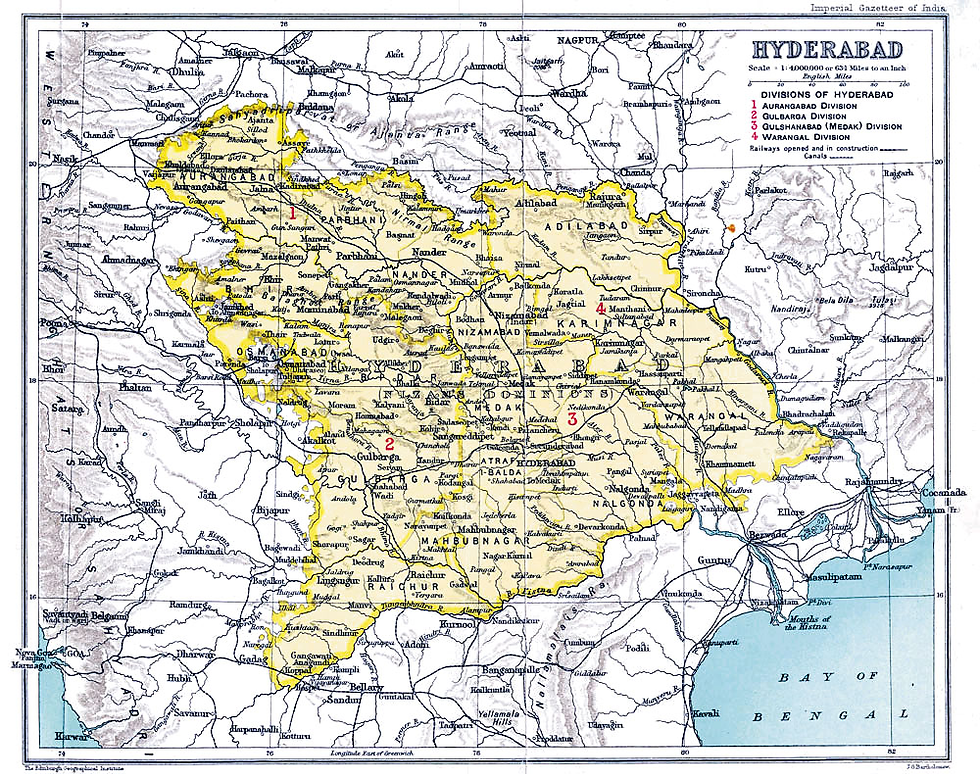
The British frequently asserted and exercised their right to intervene in Hyderabad's internal affairs, a practice that continued despite the Nizam's theoretical sovereignty. For instance, in 1902, Berar was leased in perpetuity to the Government of India, reaffirming the Nizam's sovereignty but granting administrative control to the British. By 1919, the Nizam was explicitly warned by Lord Chelmsford about the Government of India's right to intervene in cases of misrule (Ramusack & Johnson, 2004).
Geographically, Hyderabad was described as being ‘situated in India's belly’, centrally located and populated by diverse linguistic groups, including Marathi, Kannada, and Telugu speakers. It had a population of 16 million and its own currency (Menon, 1956).

Internally, while Hyderabad had a Muslim ruling dynasty and a significant Muslim population in its capital, the state as a whole had a predominantly Hindu population, especially in regions like Telangana. Movements for responsible government gained traction, and the Hyderabad State Congress sought democratic reforms. Conversely, the Ittihad-i-Muslimeen, a conservative Muslim party, grew in power, claiming to protect the Nizam's dynastic and Muslim rights (Menon, 1956; Ramusack & Johnson, 2004).

On the eve of Indian independence, the Nizam sought to maintain Hyderabad as an independent state, refusing to join either India or Pakistan. He was hostile to the idea of an "organic union" with India and explored diplomatic avenues, including appeals to the United Nations and seeking British support for his independence claims by seeking independent status under Commonwealth Nations (Menon, 1956).

The primary cause of the conflict was Hyderabad's desire for independence clashing with the Indian government's view that its accession to the Indian Union was ‘ineluctable’ due to its geographical position. Within this context, a significant agrarian upheaval led by communist guerrilla squads began in the Telangana region (eastern part of Hyderabad) in July 1946. This struggle was directed against both the feudal landlords (zamindars and deshmukhs) and the Nizam's rule (Nizamshahi). The communists aimed to address the grievances of poor peasants, who suffered from agrarian troubles, lack of medical care and education, and a system where class distinctions were brutally enforced. They redistributed land and livestock, reduced rates, ended forced labor, increased wages, and promoted social reforms like inoculation and discouraging untouchability. Communist bands, sometimes numbering thousands and armed with various weapons, assaulted landlords, seized land, and established ‘parallel governments’ in ‘liberated’ areas (Sherman, 2007).

Internal unrest and the activities of the Razakars, a Muslim paramilitary group, intensified the conflict. The Nizam's forces, including police, military, and the Razakars, attempted to repress the communist movement through mass arrests, shootings, and burning villages. The Nizam himself, in an "improbable tactical alliance" in May 1948, amnestied communists from jails and lifted the ban on the party, aiming to bolster Hyderabad's independence fight against the "bourgeois" Indian Union. However, the Razakars continued their violent activities, targeting not only Hindus but also Muslims whose loyalty was doubted, and raiding areas in neighbouring Indian provinces, causing panic and leading to a refugee crisis. The deteriorating law and order situation, coupled with the Nizam's perceived inability or unwillingness to curb the Razakars and Communists, became a critical factor. India concluded that the Nizam had lost control of his territory (Satyanarayana, 2022; Sherman, 2007).

The conflict initially saw attempts at a peaceful resolution through negotiations. A Standstill Agreement was signed by the Nizam on November 29, 1947, and by the Governor-General of India (Lord Mountbatten) on behalf of India. This agreement stipulated that, until new arrangements were made, existing agreements on matters of common concern (defence, external affairs, communications) would continue between Hyderabad and India for one year (Menon, 1956).
The Nizam's government was also accused of breaches of a temporary Standstill Agreement, including imposing a currency ordinance and providing a loan to Pakistan. Furthermore, Hyderabad was attempting to procure arms secretly from outside India. Negotiations for a long-term solution, including a "Heads of Agreement" that addressed both accession and responsible government, failed due to the Nizam's continued obstinacy and the Razakars' influence over his cabinet (Menon, 1956; Sherman, 2007).
With negotiations at a stalemate and the internal situation deteriorating, India launched a "Police Action" (Operation Polo) in September 1948. The Indian military entered Hyderabad, swiftly taking control and disbanding the Razakars. The Nizam formally surrendered, and a Military Governor's administration was established. The military intervention found that communists had caused significant damage to government structures in Telangana but had also implemented impressive reforms. Following the Police Action, the fight against communists continued, requiring "three years of ceaseless effort" and the borrowing of armed police from other provinces. The Indian government adopted a positive policy alongside suppression. This included the abolition of the jagirdari system, which existed in a most acute form in Hyderabad, and the appointment of an Agrarian Committee (Satyanarayana, 2022; Sherman, 2007).

In the aftermath of the Indian takeover in September 1948, there were reports of widespread violence within Hyderabad, with estimates of up to "one hundred and fifty thousand Muslims may have perished". Indian troops were sometimes implicated or remained aloof during these "pogroms" (Satyanarayana, 2022).
After the Police action, however, the Nizam agreed to cooperate with the Government of India. On November 23, 1949, he issued a firman (proclamation) accepting the Constitution framed by the Constituent Assembly of India as the Constitution of Hyderabad.

This proclamation clarified that the decision was subject to ratification by the people of the state, whose will, expressed through a Constituent Assembly, would determine the state's relationship with India. This was a unique step for a princely state, underscoring its shift to a constitutional relationship with the Union. Subsequently, Hyderabad's State Forces were reorganized and fully incorporated into the Indian Army by April 1, 1950. The Nizam was guaranteed a Privy Purse of Rs. 50 lakhs (in Hyderabad currency) annually, along with the enjoyment of private properties and other privileges.


This amount was significantly higher than all the other rulers, indicating a special consideration for a major state. Despite the military intervention, the Nizam was retained as the head of the state (Rajpramukh), albeit with his powers limited to a constitutional role under the supervision of the Government of India. The Indian government, influenced by the communist's social and economic uplift programs, also initiated its own development efforts for the peasantry. The ultimate goal was to abolish the feudal conditions that socialists believed could only be eradicated by dismantling the Nizam's regime, thereby establishing self-rule in India (Menon, 1956; Zubrzycki, 2023).
References:
Menon, V. P. (1956). The Story of Integration of the Indian states. Orient Blackswan.
Panikkar, K. M. (1986). The Evolution of British policy towards Indian States, 1774-1858. Mittal Publication.
Ramusack, B. N., & Johnson, G. (2004). The Indian Princes and their States. Cambridge university press.
Satyanarayana, A. (2022, September 11). Operation Polo: Integration of Hyderabad into Indian Union. Siasat.Com.
Sherman, T. C. (2007). The Integration Of The Princely State Of Hyderabad And The Making Of The Postcolonial State In India, 1948–56. The Indian Economic & Social History Review, 44(4), 489–516. https://doi.org/10.1177/001946460704400404
Zubrzycki, J. (2023). Dethroned: Patel, Menon and the integration of Princely India. Juggernaut Books.


Comments