
17 | A Decade in Decline: Dual Catastrophe of Famines and Plague at the end of 19th Century
Updated: Aug 12
By Gaurav Kalyani
Published on: 26 June 2026
Introduction
The decade preceding the 1901 Census of India was perhaps the most calamitous in the subcontinent's modern history. Two catastrophic famines in 1896-97 and 1899-1900, followed by the onset of the third plague pandemic from 1896-1899, created a crisis of unprecedented proportions. The census report of 1901 summed up the effects of these disasters on the population committed to British charge.
The total population recorded was 294,361,056 persons. While this represented a nominal increase from the 1891 figure of 287,314,671, the net increase of just 2.4 percent concealed a complex reality. When the influence of newly enumerated areas was excluded, the true rate of increase was merely 1.5 percent. It was a dramatic decline from the 10.9 percent growth recorded in the previous decade.
This essay examines the differential impact of the dual crises of Famine and Plague on the Indian population, how it was reflected in the census data, the patterns of migration they generated, and the deep imprint they left on the society.

The Famines of 1896-97 and 1899-1900:
The decade 1891–1901 brought two of the greatest famines in modern Indian history in rapid succession, with barely a year of respite between them. The Great Famine of 1896–97 affected 300,000 square miles and 70 million people. At the height of distress, an unprecedented number of four million persons were receiving daily relief (Risley & Gait, 1903).

The Famine Commission that reviewed this disaster concluded that while the area of intense distress was greater than any previous famine, the degree of success in saving human life was also greater than any comparable event (Indian Famine Commission, 1908).
However, the famine of 1899–1900 was, in many respects, worse. Though it affected a slightly smaller population, famine conditions prevailed over an area half as great. People had not recovered from the previous disaster, the drought was more severe, and cattle died in millions due to lack of fodder and water. The worst-affected areas lay largely in Princely States, where the relief organisation was far less sophisticated (Risley & Gait, 1903).
The total mortality from both famines, the census estimated, was roughly five million deaths — with around one million in British India and four million in the less well-administered Princely States (Risley & Gait, 1903).
Table: Scale of Calamities, 1891–1901
Calamity | Area / Population | Peak on Relief | Est. Deaths | Notes |
Scarcity 1891–92 | Madras, Bombay, Bihar | ~0.5M | Low | Contained; no widespread mortality |
Crop failure 1895–96 | U.P. southern districts | ~0.5M | Moderate | Early warning of worse to come |
Great Famine 1896–97 | 300,000 sq. miles; 70M people | 4.0M daily | ~1M (est.) | Largest area ever affected; relief broadly successful in British India |
Famine 1899–1900 | 450,000 sq. miles; 60M people | 6.2M daily | ~4M (Native States + British) | More intense; Native States less prepared; cattle mortality catastrophic |
Sources: 1901 Census of India, Part I, and provincial chapters. True death figures are census estimates, not registered totals.
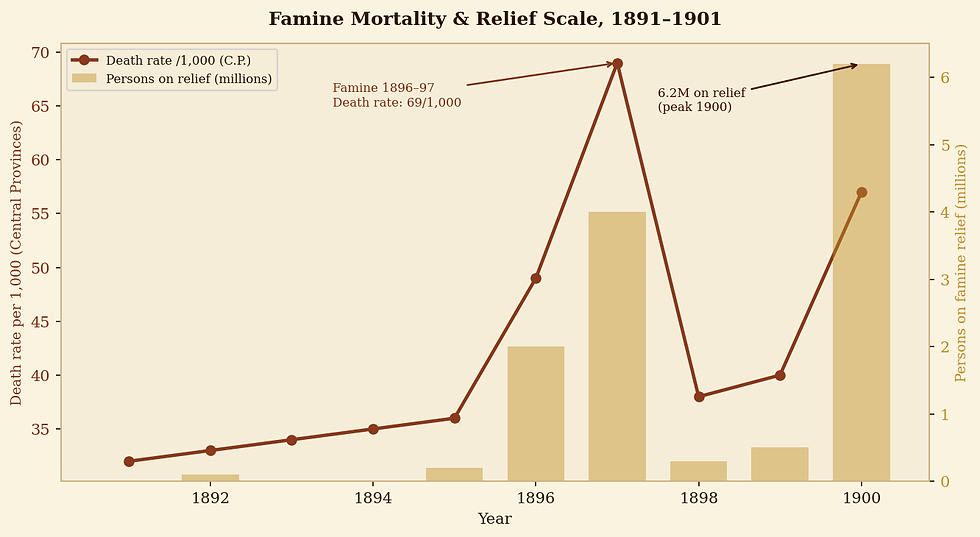
The geographical pattern of famine impact was sharply delineated. The Central Provinces suffered devastating losses, with its population declining by 1,071,776 persons or 8.3 percent during the decade. The census report observes that "the events of the ten years preceding the last census have signally falsified the optimistic views of the first Famine Commission" (Risley & Gait, 1903).
The most striking evidence of famine's impact comes from the vital statistics. In Berar, the death rate rose from 40 to nearly 83 per thousand during the famine of 1899-1900; the birth rate fell from 50 to 31. The report noted, "the number of deaths returned was 236,022, being nearly 126,000 in excess of the decennial average" (Risley & Gait, 1903).


The census report also provides a harrowing account: "Not only did both the autumn and spring crops fail completely; there was also a dearth of fodder; the stores of grain which are still habitually maintained had been exhausted in 1897 and not replenished in the following year, and, to complete the disaster, the sources of water-supply dried up and a large number of cattle perished from thirst" (Risley & Gait, 1903).
Chapter II of the Census report summed it up clearly,
"It has been repeatedly shown how intimately the variations revealed at succeeding enumerations are connected with the occurrence of famine. When there has been a famine in the period between two censuses, the population is stationary or decadent; but when there has been no famine, it is progressive” (Risley & Gait, 1903).
Following the famine of 1899-1900, Lord Curzon set up a Famine Commission which submitted its report in 1901. This report sought to define the Famine Codes, drawing from the lessons from recent experiences across Provinces of Bombay, Central Province, Berar, Punjab etc. The Commission estimated total excess mortality in British territories was about one million lives, along with the loss of four million cattle (Indian Famine Commission, 1908).
A central theme of the report was the importance of ‘moral strategy’, the idea that acting early to give people ‘heart’ prevents the depression and physical deterioration that lead to higher death rates. The Commission stressed that relief must be ready before the pressure becomes severe, including early suspensions of revenue and the enlistment of non-official agencies (Indian Famine Commission, 1908).
One of the most controversial recommendations was the abolition of the minimum wage for the able-bodied. The Commission argued that the minimum wage had become a hurdle, and instead recommended a system of payment by results with no minimum wage guarantee. The Commission also stressed on the importance of establishing Agricultural Banks that could provide access to credit at reasonable rates. The hope was that it would free the cultivators from the burden of heavy interest rates charged by money-lenders (Indian Famine Commission, 1908).
Famine, the census observed, killed selectively, following the contours of social vulnerability. In the Central Provinces, a province-wide analysis of caste-level losses showed that Dravidian tribal peoples lost nearly 12 percent of their number. The Kols lost 15 percent; the Kandhs and Gonds, 13–14 percent each. As one ascended the social hierarchy, the losses diminished. Lower artisans castes lost 6 percent; higher cultivators, 5 percent; higher artisans and traders, about 4 percent. For the higher castes such as Brahmins, Rajputs, Kayasths, Banias, the loss was 159 persons, or about 0.01 percent (Risley & Gait, 1903).
In Berar, of 545,127 births registered in the five years 1896–1900, only 287,986 children were alive at census day, a nearly 47 percent of infant mortality. The number of children under ten in 1901 was 38.2 percent lower than in 1891. The elderly were similarly affected: persons aged 60 and over fell by 27.2 percent. But those between the ages 15 to 40, were actually proportionally greater in 1901 than in 1891, precisely because the young and old had been stripped away around them (Risley & Gait, 1903).
The Plague Epidemic
Bubonic plague was first detected in Bombay City in September 1896. It gradually spread to other parts of the country. The provinces of Bombay, Bengal, Mysore, Baroda and Hyderabad suffered greatly. By the date of the census, "the recorded mortality was nearly half a million, to which Bombay contributed seven-tenths and Bengal two-thirds of the remainder; Mysore with 35,731 reported deaths had suffered heavily in proportion to its population and so too had Baroda and Hyderabad". The total registered mortality from plague up to 1st March 1901 was nearly a third of a million (Risley & Gait, 1903; Sarkar, 2024).

Table: Reported Deaths from Plague in 1901.
Province | Number of Registered Deaths (1901) |
Bombay | 70,388 |
United Provinces | 20,573* |
Punjab | 14,959* |
Mysore State | 35,731 |
Bihar and Orissa | 8,241 |
Data compiled from annual vital statistics reports showing the immediate impact of the plague across major provinces during the 1901 census period (Gait, 1913, p. 204; Risley & Gait, 1903)
*Note: For the United Provinces and Punjab, figures represent combined male and female registered deaths
Table: Plague Mortality Statistics (c. 1896 – March 1, 1901)
Region | Officially Recorded Deaths | Estimated True Mortality / Notes |
All-India | ~500,000 | 750,000 to 1,000,000 |
Bombay Presidency | ~350,000 | 500,000 to 666,000 (est. reduction in population) |
Bombay City | 114,000 | Epicenter; registered mortality peaked at 2,820/week in 1899–1900 |
Bengal | ~100,000 | Primarily concentrated in Calcutta (~64,000 deaths total) |
Mysore State | 35,731 | Suffered heavily in proportion to its total population |
Hyderabad State | 7,811 | Primarily in districts bordering Bombay, such as Oosmanabad |
Baroda State | Suffered heavily | Specific figures for the decennial period not isolated in summary |
Sources: 1901 census report; Sarkar, 2024; Dyson, 2018
The plague's impact on Bombay City was particularly devastating. Many people fled from Bombay city at that time, and in the census of 1901, the population had fallen to 780,000 from 821,764 in 1896, a decrease of about 6 percent (Risley & Gait, 1903).
The census report notes that plague had severely affected the city’s prosperity, not only by the heavy mortality that it has caused, which is estimated to have amounted to 114,000 up to the date of the Census, but also by the mass exodus of the population out of the city (Risley & Gait, 1903).


The plague exhibited distinct patterns of mortality by class and community. In Bombay, plague death rates between 1897 and 1900 constituted 2 per 1,000 among Europeans, around 10 per 1,000 among Parsis, Jews and Eurasians, 15 per 1,000 among Hindu Brahmins and exceeded 20 per 1,000 for other Hindu castes (Risley & Gait, 1903).
The Census also noted a higher mortality rate among women than men, attributing it to a combination of environmental factors and social barriers. Dyson (2018) & Sarkar (2024), observed that the nature of women’s daily lives, both in rural and urban India, placed them at a much higher risk of infection as they were at the risk of more close and frequent contact with house rats and infected fleas.
The regional variation in plague impact was significant. Punjab was the worst affected Province, losing around 4 million people between 1896 and 1918. The United Provinces lost over 3 million lives, while the Bombay Presidency lost over 2 million. In contrast, eastern and southern parts of the subcontinent were significantly less affected. This regional variation was later attributed to the behaviour of rodents and fleas rather than human factors (Tumbe, 2020).
The Census Operations and Enumerators were also significantly affected due to the plague, since conducting the census was incredibly dangerous, as enumerators were heavily exposed to infection. Notably, in a remarkable display of public service, the teaching staff and senior students of the Elphinstone High School voluntarily came forward to conduct the entire census operations for their quarter of Bombay City. However, several of these volunteer enumerators sadly contracted the disease and died (Risley & Gait, 1903).
On the other hand, despite the disease raging in Bombay City, Belgaum, and Thana at the time of the count, the Census Superintendent, Mr. Enthoven found that the plague actually proved to be a help rather than an obstacle to the enumeration. While outbreaks caused severe alarm and confusion in other provinces, the initial days of panic in Bombay had passed, and the public had already become entirely accustomed to frequent censuses being taken for plague-control purposes (Risley & Gait, 1903).
The plague was far more devastating in towns than in the countryside. Major cities like Bombay and Indore experienced massive population drops not just from deaths, but from a ‘plague exodus’, where thousands of panic-stricken residents fled to the interior to avoid infection. These frequent outbreaks acted as a serious detriment to industrial progress, as the constant threat of disease interrupted the usual flow of new workers from rural areas (Risley & Gait, 1903).
Early colonial scientific theories about the spread of plague attributed it to Miasma or noxious, ‘bad’ air emanating from soil and decaying matter. Research in India eventually proved that fleas on rats were the main cause of the spread (Dyson, 2018). The breakthrough came in Hong Kong when Alexandre Yersin (and Shibasaburo Kitasato) isolated the bacillus Yersinia pestis (Tumbe, 2020, Sarkar, 2024).
Shortly after the plague reached Bombay, Waldemar Haffkine developed a vaccine in Bombay to help protect the population (Sarkar, 2024). After reaching a peak in 1907, the disease slowly began to decline as people developed natural immunity. Better grain storage also helped by keeping rats away from people's homes (Dyson, 2018, p. 180). Overall however, the plague remained a serious problem for the census and for the country’s growth for many years (Risley & Gait, 1903).

Displacement patterns
The census data reveal extensive migration triggered by these two crises. The famine of 1896-97 had a particularly significant impact on migration patterns. The census report notes that the general flow towards towns may possibly have been intensified at the present Census by the famine of 1900, driving some of the poorer sections of the rural population to seek a livelihood in neighbouring towns (Risley & Gait, 1903).
Conversely, the Bombay Presidency experienced significant out-migration during the plague. The report observed that "the number of immigrants of all kinds has fallen from 988,080 in 1891 to 801,014 at the present census, and that of emigrants to other parts of India from 700,542 to 626,799". In Gujarat, the number both of immigrants and of emigrants, but especially of the latter decreased (Risley & Gait, 1903).
The famine drove people from the Native States into British territory in search of relief. The Famine Commission of 1901 observed that Gujarat is interlocked with native states and that there was overwhelming evidence to show that immense numbers of refugees came across the border in extreme destitution to seek relief in British territory (Indian Famine Commission, 1908).
Assam experienced significant immigration during this period. As the census report quotes, "The foreign-born denizens of Assam have risen from half to three-quarters of a million, and now form no less than an eighth of the population of the province". People mainly migrated from areas such as the Chota Nagpur plateau in Bengal, the United Provinces, the Central Provinces, Madras and the Native States of Rajputana and Central India. The census report noted that the reason for this increase in volume was due to extensive tea cultivation and the 1897 famine acting as a powerful stimulant (Risley & Gait, 1903).
According to the 1901 Census report, the plague and famine had markedly different, and often opposing, impacts on city populations. The famine generally acted as a centripetal force, driving rural populations toward cities in search of work, while the plague acted as a centrifugal force, causing mass flight and deterring new arrivals (Risley & Gait, 1903).
Opposing Migration Patterns:
Famine as an Urban Driver - The report notes that the famines of the 1890s tended to drive the people to big centres of commerce, in search of work. In several afflicted areas, the census suggests that the ‘general drift towards towns’ was likely intensified as the rural poor sought any available livelihood in neighbouring urban centers.
Plague as an Urban Deterrent - Conversely, the plague caused a significant dispersion of city dwellers. In Bombay City, the population actually declined by about 6% between 1891 and 1901, a loss attributed to the temporary departure of many of the regular inhabitants. People fled out of fear of the disease. In Calcutta, though the epidemic was less severe than in Bombay, the census observes that it deterred many people from immigrating, who would otherwise have done so.
Bombay City alone, nearly 9,000 houses were found unoccupied on census night because of the plague exodus. The report states that the influence of famine in driving people to cities was counterbalanced by the direct and indirect effects of the plague (Risley & Gait, 1903).
Socio-Cultural Responses to the Crises
The social response to these catastrophes revealed deep tensions between colonial authority and Indian society.
The Epidemic Diseases Act of 1897 gave the government sweeping powers to inspect public places and homes, and to isolate anyone suspected of being infected with plague. These measures provoked widespread resistance (Ramanna, 2024).

Nearly 10 percent of the population of the Indian subcontinent, or over 30 million people were moved temporarily into camps at some point during the plague pandemic. Lakshmibai Tilak's memoir provides a vivid account of the horrors of quarantine camps. She described them as places of terror where "the sick screamed and beat on the tin walls" and where 90 percent of those infected died after they arrived (Tumbe, 2020).

In rural areas, people often resisted plague measures through flight or rioting. In April 1900, riots broke out in Kanpur when a segregation camp was attacked by millhands and others because of the forceful detainment of women (Sarkar, 2024).
The plague also transformed public understanding of rats and rodents. The discovery of the rat-flea-human transmission mechanism, led to new strategies for plague control. The campaigns revolved around an elaborate system of rat trapping, collection, and examination. Rat-catching caught on as an occupation across municipalities in India (Sarkar, 2024).

In Bombay, thousands of buildings were cleared out, property was destroyed, and drains were regularly cleaned. Houses were lime-washed and sulphur was burnt inside. The body searches conducted at railway stations were considered humiliating, especially when women were searched by male officials. The lack of observation of caste and religious rules in hospitals hurt the elite. The Parsis, Jains, and other communities responded by setting up temporary hospitals for their own kind (Tumbe, 2020, Ramanna, 2024).


In Poona, the measures were even more draconian. W.C. Rand, Chairman of the Poona Plague Committee, was resented for employing harsh containment measures, with intensive house searches conducted by European troops to identify sick people and transfer them to the hospital. Accusations of forced examination and misconduct, especially with women, spread. Ultimately, Rand was assassinated on 22 June 1897 by Chapekar brothers. The assassination was praised by Congress leader Bal Gangadhar Tilak through his newspapers, leading the government to arrest Tilak for sedition and his imprisonment (Tumbe, 2020, Ramanna, 2024).

The plague also had significant political consequences. The plague politics in Poona became instrumental in creating an aura around Tilak. It became even more important for his rival, Gopal Krishna Gokhale, who was more moderate. He worked with the government and aided a volunteer service on plague relief, culminating in the creation of the Servants of India Society in 1905 (Tumbe, 2020, Ramanna, 2024).
Savitribai Phule, co-founder of Satyashodhak Samaj, and her son Dr. Yashwant Phule, established a clinic in Hadapsar, on the outskirts of Poona to treat the afflicted and curb the spread of plague. Defying the rigid caste hierarchies of the time, they ensured their clinic welcomed patients from all communities, a radical stance against the prevailing norms that often denied treatment to lower-caste individuals. Savitribai herself contracted the plague while trying to save a child, and died on March 10, 1897 (Tumbe, 2020).
During the Pandemic many Indians viewed the plague as a manifestation of supernatural wrath or an act of God. Bhagirathi, who was a healer in Bombay during the early 20th century, emerged as a powerful personification of the plague, eventually being transformed into a ‘veritable goddess’ by those seeking spiritual protection during the epidemic (Sarkar, 2024). Sarkar (2024) argues that the veneration of Bhagirathi was a form of ‘non-biomedical alternative’ that the public took refuge in during a time of extreme colonial intervention. She was eventually arrested by the colonial government for endangering public health.
Famine Relief
The famines of the 1890s were the first major test of the Famine Codes that had been developed following the 1876-78 famine. The codes systematized famine relief with the aim of providing timely action and establishing large-scale public relief works. However, the implementation was often harsh. In Hissar district during the 1899-1900 famine, the relief works were deliberately designed to involve such unpleasant work at so low a wage that only the really desperate would come to them (Indian Famine Commission, 1908).
Table: Total number of persons receiving relief.
Name of Province | Preceding Week: Relief Works | Preceding Week: Gratuitous Relief | Preceding Week: Total | Present Week: Relief Works | Present Week: Gratuitous Relief | Present Week: Total |
Madras | 37,389 | 10,774 | 48,163 | 43,508 | 11,595 | 55,103 |
Bombay | 348,572 | 13,126 | 361,698 | 342,036 | 16,402 | 358,438 |
Bengal | 265,347 | 101,220 | 366,567 | 300,763 | 134,270 | 435,033 |
North-Western Provinces and Oudh | 1,126,289 | 278,247 | 1,404,536 | 1,250,258 | 279,673 | 1,529,931 |
Punjaub | 79,664 | 26,575 | 106,239 | 78,712 | 30,892 | 109,604 |
Central Provinces | 251,796 | 64,817 | 316,613 | 238,299 | 68,749 | 307,048 |
Burmah | 27,225 | 5,857 | 33,082 | 23,915 | 5,463 | 29,378 |
Berar | 2,152 | ... | 2,152 | 5,883 | ... | 5,883 |
Central India | 69,321 | 4,344 | 73,665 | 90,930 | 4,897 | 95,827 |
Rajputana | 24,327 | 2,819 | 27,146 | 19,492 | 2,348 | 21,840 |
Grand Total | 2,232,082 | 507,779 | 2,739,861 | 2,393,796 | 554,289 | 2,948,085 |
Source: Merewether, 1897
The relief administration was often more concerned with cost and deterring opportunists, rather than with saving lives. Wages were often below survival level. Children over the age of ten had to work, while younger and very old dependents were given free allowances but were obliged to appear daily at the works. The harshness of the relief administration contributed to the greater mortality of the later famine (Indian Famine Commission, 1908; Risley & Gait, 1903).
The famines provided a powerful platform for nationalists like Dadabhai Naoroji and Romesh Dutt, who argued that British policies overtaxed farmers and drained resources, making the population more vulnerable to drought (Dyson, 2018).
However, the census report noted that the mortality caused by the famines of 1896-97 and 1899-1900 could have been far excessive in those years, which it argued was a remarkable proof of the efficiency of the relief operations. It highlighted the role of railways in famine mitigation. It also observed that Famine hindered the spread of education. Families could not afford school fees and required children to assist in domestic tasks like herding cattle or collecting fuel (Risley & Gait, 1903).
The devastation caused by both the Famines and the Plague were also noted by the global media. The Eastern Utah Advocate in the United States published a report on the ‘Depopulation of India’ in 1901. It noted that an estimated five million people have perished in India since 1896 due to Famines and Plague combined (Eastern Utah Advocate, 1901).
Conclusion
The 1901 Census of India stands as a document of demographic catastrophe and resilience. It reveals a population that had endured the worst famines of the century and the onset of a plague pandemic that would claim millions more lives in the decades to come. The census data show the stark contrast between British territories, where the population grew by 3.9 percent, and Native States, where it declined by 6.6 percent. They revealed the differential impact of famine on the very young and the very old, the disproportionate mortality among certain castes and communities, and the massive displacement of people driven by hunger and disease.
The socio-cultural responses to these crises, from the establishment of community hospitals to the resistance against colonial plague measures, foreshadowed the broader nationalist movement that would gather momentum in the following decades.
The decade of 1891-1901 would not be the last time India would face such catastrophic losses. But the census of 1901, with its meticulous documentation of population, age, sex, religion, and migration, provided the statistical foundation upon which future generations would understand and respond to the demographic challenges facing the subcontinent.
Bibliography
(1901). Depopulation of India. Eastern Utah Advocate. Utah.
(1908). Report of the Indian Famine Commission, 1901. Superintendent Government Printing. Calcutta.
Dyson, T. (2018). A Population History of India - From the First Modern People to the Present Day. Oxford University Press.
Merewether, F. H. S. (1898). A Tour Through the Famine Districts of India. A. D. Innes & Co.
Ramanna, M. (2024). The Plague Epidemic in Bombay and Poona, 1896–97—Perceptions of the Contemporary Print Media. In K. Mohan & S. K. Rai (Eds.), Pandemics and Literature (1st ed.). Routledge India.
Risley, H. H., & Gait, E. A. (1903). Census of India, 1901. Volume I. India. Part I—Report. Calcutta: Office of the Superintendent of Government Printing, India.
Sarkar, N. (2024). The Last Great Plague Of Colonial India. Oxford University Press.
Tumbe, C. (2020). The Age of Pandemics, 1817-1920: How they shaped India and the world. HarperCollins Publishers India.


Comments