
19 | The Languages of India: A Survey of the Linguistic Families of the Indian Empire
Updated: Jun 27
Published on: 27 June 2026
The essay below is the summary of findings from G.A. Grierson, 'Language', Chapter VII in Census of India, 1901, Part I: Report, 1903.
When the Census of India was conducted in 1901, no single chapter better embodied the astonishing complexity of the subcontinent than Chapter VII: Language. Its author, Sir George Abraham Grierson — the presiding genius of the Linguistic Survey of India — brought to bear nearly three decades of painstaking fieldwork, a command of dozens of languages, and a scholar's precision to produce what remains one of the most comprehensive accounts of India's linguistic landscape ever assembled.
Grierson opened the chapter with characteristic candour, confessing that the classification he offered must be considered provisional: discoveries made even after drafting required the rewriting of large portions. The Survey, not yet complete in 1901, had already overturned "several theories hitherto accepted by all scholars as certainly correct." The chapter is thus simultaneously a monument of Victorian scholarship and a live document of discovery in progress.
No less than 147 distinct languages were recorded as vernaculars in the Indian Empire in the 1901 Census — and this figure deliberately excluded vast tracts of Baluchistan, the Himalayas, parts of Burma, and Afghanistan where no language census was possible. Grierson organised these languages by arranging them in a "rough order of antiquity," beginning with the likely oldest inhabitants and proceeding to the most recent arrivals.

The Indo-Chinese Family
Grierson placed the Indo-Chinese family first, not because it was the largest, but because its eldest branch — the Mon-Khmers — likely represent the earliest Indo-Chinese inhabitants of Further India. This immense family spans, in its global reach, from Central Asia to the Malay Peninsula and from Baltistan to Peking. It exhibits two of the three great types of human speech: isolating languages (like Chinese, where words never change form) and agglutinative languages (like the Tibeto-Burman tongues, where layers of prefix and suffix build complex meaning).
A remarkable feature of Indo-Chinese languages is their system of tones. Grierson, drawing on the work of Professor Conrady of Leipzig, explained that these pitch-tones arose from the gradual disappearance of word-prefixes. When a dissyllabic word lost its unaccented prefix through phonetic attrition, the resulting monosyllable was "compensated" by being assigned a particular musical pitch. Chinese, having lost all prefixes, has the most tones (up to eight in Mandarin); Burmese, retaining prefixes more freely, has only two or three.
The Mon-Khmer Sub-Family
The oldest Indo-Chinese inhabitants of India were the Mon-Khmers, now driven to the sea-coast of Further India or surviving in highland pockets. Their languages include Mon (or Talaing) of the Gulf of Martaban coast, Palaung and Wa of the upper Mekong region (Burma), and remarkably, Khassi of the Khasi and Jaintia Hills of Assam — an island of Mon-Khmer speech in a sea of Tibeto-Burman tongues. Grierson noted a profound connection between Mon-Khmer vocabularies and those of the Munda languages of central India, suggesting a vast common substratum stretching from Australia to Further India.Mon-Khemer languages were later grouped under the Austro-Asaiatic group of languages, and it is reflected as such from the 1911 Censuses.
The Tibeto-Burman Sub-Family
The Tibeto-Burman tribes migrated in waves from a hypothetical original home near the upper courses of the Yang-tse-kiang in north-western China. Their migrations populated Tibet, descended the Brahmaputra into Assam, filled the Naga Hills, occupied Manipur, and ultimately sent the ancestors of the Burmese down the Irrawaddy to found the capitals of Pagan and Prome. Grierson's classification divides this rich family into several branches:

The Siamese-Chinese Sub-Family
The third and most recent of the great Indo-Chinese invasions into Further India was that of the Siamese-Chinese (Most of these speakers were in modern Burma), comprising the Karen languages (whose origins Grierson found difficult to place precisely), the Chinese proper, and the great Tai or Shan group. The Tais first appeared historically in Yün-nan, descended into Upper Burma, and their most important branch — the Ahoms — overran and conquered Assam in the thirteenth century, giving the province its very name. The Shan languages spoken in Assam include Khamti, Phakial, Nora, Tai-rong, and Aiton, each with its own dialect and alphabetic tradition.
The Selungs are a tribe of sea-gipsies inhabiting the islands of the Mergui Archipelago. Their language is most nearly related to the Cham or Tiam spoken by the aborigines of Cambodia — two languages of the family which belong to the mainland of Asia. This may assist ethnologists in determining the original home of the Malay nationalities.
— G.A. Grierson on the Malay Group (Malayo-Polynesian Family
The Dravido-Munda Languages
Grierson grouped the Munda and Dravidian languages into a common super-family, noting that they share a remarkable vocabulary substratum and may have a common prehistoric origin. Whether the Dravido-Mundas entered India from the north-west, the north-east, or — most probably, in Grierson's view — from the south, is a question he left for ethnologists.
The Munda Sub-Family
The Munda languages — formerly often called "Kolarian," a term Grierson found imprecise — are agglutinative tongues of extraordinary complexity and regularity. Their heartland in 1901 was the north-east of the central plateau of India: the Sonthal Parganas (Santhal Paraganas), Chota Nagpur, Orissa, and Chhattisgarh. Grierson quoted Max Müller's lyrical description of Turkish grammar to illustrate the Munda system, noting that it applied with equal force to Santali, the most important Munda language.
The word dal means "strike," and from it we get dal-ocho-akan-tahen-tae-tin-a-e, which signifies "he, who belongs to him who belongs to me, will continue letting himself be struck." The conjugation of the verb "to strike" in the third person singular alone occupies nearly a hundred pages in Mr. Skrefsrud's Santali Grammar.
The Munda languages share several distinctive features: four semi-consonants whose breath is expelled through the nose; two genders (animate and inanimate, not masculine and feminine); three numbers (singular, dual, plural); and — crucially — two first-person plural pronouns, one including the person addressed and one excluding him. Speaking to your cook about dinner using the wrong form could inadvertently invite him to the table.The principal languages of the family include:Santali, Mundari, Ho, Bhumij, Kurku, Korwa, Sora (Savara), Juang, Kharia, Birhor.
Note that Munda sub family was later grouped under Austro Asiatic family and reflected in Census 1911 onwards.
The Dravidian Sub-Family
The Dravidian sub-family, far more numerous than its Munda counterpart, broadly forms the speech of southern India, bounded roughly on the north by the district of Chanda in the Central Provinces. In addition to this great southern block, islands of Dravidian speech extend far northward into central India, and — most anomalously — the language Brahui appears in distant Baluchistan, a lone Dravidian outpost in a world of Eranian and Indo-Aryan tongues.
Sanskrit writers had divided the speeches of Southern India into two — Andhra and Dravida — a division Grierson found well borne out by modern conditions. Telugu descends from Andhra; Tamil and its family from Dravida.
The Dravidian languages are characterised by:
Postpositions rather than prepositions
Two first-person pronouns ("we" inclusive and exclusive)
No passive voice — expressed through verbs meaning "to suffer"
Adjectives incapable of declension
Extensive use of relative participial nouns instead of relative pronoun clauses
Dative suffix ku / ki / ge with no Sanskrit analogue

Tamil
Tamil is placed first among Dravidian languages not for its numbers but for its antiquity and culture. It covers all of Southern India to Mysore and the Ghats, reaches northward as far as Madras, is spoken in Northern Ceylon, and its emigrants carry it to Burma, the Straits Settlements, Mauritius, and the West Indies. It possesses two forms: the literary Shen (perfect) Tamil, highly artificial, and the Kodum (rude) Tamil of ordinary life. Its alphabet traces through the Grantha character back to the Brahmi of Asoka.
Telugu
More widely spread than Tamil as a vernacular, Telugu occupies practically the entire eastern peninsula. It is described by Grierson as ranking "next to Tamil in respect to culture and copiousness of vocabulary, and exceeds it in euphony." Its alphabet has the same ultimate Brahmi origin as Tamil's, but came down through the Vengi and Chalukya scripts of the seventh century, and the characteristic curvature of its letters reflects the practical necessity of writing with a stylus on palm-leaf without splitting the grain.
Brahui
The strangest of all Dravidian languages, Brahui is spoken in the highlands of Baluchistan — a linguistic island, thousands of miles from its nearest southern relatives. Dr. Trumpp proved in 1880 that the connection with the Dravido-Munda stock is genuine; Grierson confirmed it through the Linguistic Survey. Whether Brahui is the advance guard of a northward Dravidian migration or a remnant of once-wider distribution, it stands as testimony to the enormous historical reach of the Dravidian world.
The Indo-European Family: The Aryan Sub-Family
Numerically dominant, the Aryan languages of India are a branch of the great Indo-European family — the satem-speakers who wandered east from an original home in the steppes of Southern Russia (following the latest researches of Professor Otto Schrader available to Grierson), settling first near Khiva and Badakhshan before separating into Eranian and Indo-Aryan streams.
The Eranian Branch (Iranian)
The Eranian (Iranian) languages — spoken on India's north-western frontier — descended from the eastern group of the great Medic branch. The most important in the Indian census were:
Baloch (Baluchi) — the language of Baluchistan, extending to the Indus on the east and the Arabian Sea on the south. In its phonology, Baloch is the most archaic of the eastern Eranian languages, preserving consonants that had begun to erode in Persian fifteen hundred years ago.
Pashto — spoken in the trans-Indus districts and in Afghanistan. A rugged, virile language, Pashto has two main dialects: the north-eastern Pakhto and the south-western Pashto (the very names illustrating the dialectic difference in pronunciation of the same word). Its speakers, the Pathans or Pashtana, have invaded India multiple times; Sher Shah, the Emperor of Delhi who briefly displaced the Mughals, was of Afghan origin.
The Ghalchah languages — a cluster of languages spoken in and around the Pamirs, including Wakhi, Shighni, Ishkashami, and Munjani. Only Yidgha had crossed into the Indian census area by way of the Dorah Pass into Chitral.
The Indo-Aryan Branch
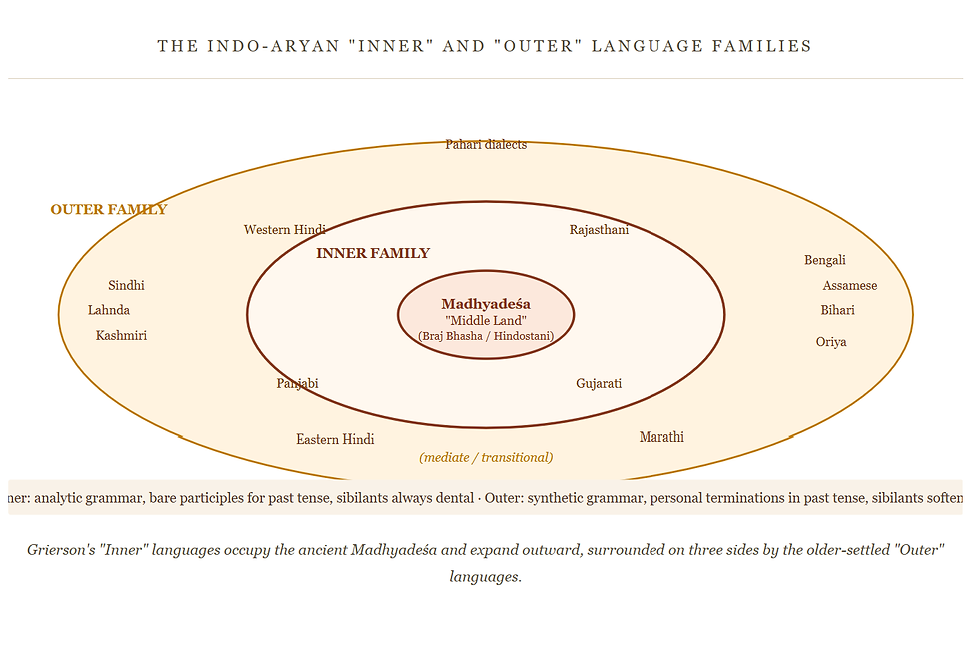
The Indo-Aryan languages form by far the largest linguistic group of the subcontinent. They descend, via a long chain of Prakrit dialects, from the Vedic dialects of the original settlers who entered India through the passes of the Hindu Kush. Grierson's signal contribution was to identify two great families within the Sanskritic Indo-Aryan languages — the Inner and Outer families — based on the route and timing of successive immigrations.
The Inner Group
The Inner family — occupying the ancient Madhyadesa, the Middle Land — comprises the languages of the later Indo-Aryan immigration. Their grammar is analytic: inflections have largely dissolved, and grammatical relations are expressed by separate auxiliary words (ka, ko, se in Hindi). In the past tense, the bare participle serves for all persons without change. Their sibilants are always a clear dental s. The Inner languages include Western Hindi (with Braj Bhasha, Hindostani, Kanauji, and Bundeli), Rajasthani, Gujarati, and Punjabi.
The Outer Group
The Outer languages, in contrast, went a stage further in their linguistic evolution. After an analytic phase, they re-developed synthetic forms by incorporating auxiliary words directly into the main word. They have personal terminations in the past tense — a point of grammar that distinguishes them sharply from the Inner family. Their sibilants are typically softened (Bengali pronounces s as sh; Sindhi drops it to h). The Outer family includes Sindhi, Lahnda, Kashmiri, Marathi, Oriya, Bihari, Bengali, and Assamese. Eastern Hindi occupies an intermediate position, descended from the ancient Ardha-Magadhi Prakrit.

The Non-Sanskritic Indo-Aryan Languages
Grierson proposed a second, smaller wave of Indo-Aryan immigration — entering India from the Pamirs through Chitral and Gilgit rather than the Kabul Valley. These languages, which he termed Non-Sanskritic, show connections to the Ghalchah (Eranian) languages of the Pamirs that the main Sanskritic family does not share. They include Shina (of Gilgit and the Indus Kohistan), Khowar (of Chitral), the Kafir group (Bashgali, Wai, Veron, Ashkund) of Kafiristan, and the Kalasha-Pashai group. All are spoken in mountainous tracts on or beyond the northern frontier, and none had any literature.
The Journey of Sanskrit to the Modern Vernaculars
Grierson traced a carefully articulated genealogy from the Vedic dialects of ancient India down to the modern vernaculars, distinguishing three stages of Prakrit: the Primary Prakrits (the actual vernaculars of the Vedic period), the Secondary Prakrits (the stage of the Asoka inscriptions, Pali, and the literary Prakrits of the dramatists), and the Tertiary Prakrits (the modern vernaculars as they have existed for the past nine centuries). The boundary between stages is deliberately blurred — as Grierson noted, linguistic change is never a sharp step but a gradual flow.
A key concept in this analysis is the distinction between Tatsamas (Sanskrit loan-words borrowed in modern times) and Tadbhavas (words that descended organically through the Prakrit chain). Grierson observed, with some alarm, that the fashion for loading literary Bengali and Hindi with Tatsamas was creating a gulf between the literary language and the spoken vernacular — a "Sanskrit revival" that threatened to stunt these languages' natural development.
Hindostani: The Lingua Franca of India
Among the Inner languages, Hindostani occupies a special place — not as the purest or most literary, but as the lingua franca of the entire subcontinent. Originally the vernacular of the Upper Gangetic Doab (around Meerut), it was carried everywhere by the officers of the Mughal Empire.
In its Urdu form (written in Persian script, enriched with Persian and Arabic vocabulary) it reached Delhi and Lucknow; in its Hindi form (Sanskriticised vocabulary, Devanagari script) it is the prose literary standard of Hindu North India. Grierson was emphatic that Urdu and Hindi are, at their roots, the same language — Hindostani — distinguished only by their literary dress.
The contrast between the two literary styles was vividly described: in extreme Urdu, a sentence might contain only Persian words except for its verbs; in extreme literary Bengali or Hindi, a passage might consist almost entirely of Sanskrit borrowings unintelligible to the uneducated speaker of the language. Grierson's sympathy lay clearly with the vernacular — he cited Tulsi Das's Ramayan in Awadhi as a supreme example of literature rooted in the living speech of the people.
Unclassified Languages and the Fringes of Knowledge
No survey of Grierson's chapter would be complete without noting the languages that resist classification — perhaps the most intriguing entries in the entire report.
Burushaski, spoken by the Hunza Nagar tribes on the extreme north-western frontier, stood as a complete philological riddle. No scholar had placed it convincingly in any known family. Grierson noted with mild scorn that one gentleman had claimed it was a "Siberio-Nubian" tongue — "a name which may be comforting to some people, and which has the doubtful advantage of being unintelligible to everyone except its inventor." (Modern linguists still classify Burushaski as a language isolate.)
Andamanese — the languages of the Andaman islanders — were similarly unclassified. All agglutinative, making free use of prefix, infix, and suffix, they could express only simple ideas; abstract thought was largely beyond them, with meaning eked out by gesture.
There were also the Gipsy dialects — the speech of wandering clans such as the Brinjaras (Banjaras), Ods (Waddars), and Nats. Grierson observed that these were often less genuine languages than professional argots: "Some of these tongues are simple thieves' patters, made up by altering the order of the letters in good Hindi words." He also noted the well-established theory that the European Gypsies (Romani) were of Indian origin, likely descending from a community speaking one of the non-Sanskritic Indo-Aryan languages.

India as a Laboratory of Human Speech
Grierson closed his monumental chapter with a passage of rare eloquence, listing the contrasts that make India's linguistic landscape unlike any other on earth. At one extreme stood the "rude languages of the “naked savages” of Eastern Assam, which have never yet been reduced to writing"; at the other, languages with thirty centuries of literary tradition, grammars as complete as Greek or Latin, and poetry of the highest spiritual attainment.
The chapter illuminates several great themes of linguistic science, each illustrated with Indian evidence:
Language and migration: The distribution of language families across the subcontinent is a palimpsest of successive migrations — Mon-Khmers, Tibeto-Burmans, Indo-Aryans, each displacing or absorbing their predecessors and leaving traces in the languages of the survivors.
Language contact and borrowing: No Indian language is "pure." The cerebral consonants of Indo-Aryan came from Dravido-Munda influence. The past tense construction of Hindi reflects a Tibeto-Burman syntactic pattern. Arabic and Persian saturate the vocabulary of Urdu. English words spread through the railways and the cantonment.
Language and social prestige: Grierson was alive to the politics of language. He lamented the excessive Sanskritisation of literary Bengali and saw with concern the same trend threatening Hindi. He praised Tulsi Das for writing in Awadhi, the living vernacular, rather than in artificial Sanskrit. He was sensitive to the way that tribal names for languages obscure real linguistic relationships — and to the way colonial administrators often invented language names that no native speaker would recognise.
The limits of knowledge: Throughout, Grierson maintained scholarly humility. The Linguistic Survey was not yet complete. Burushaski defied classification. The boundaries between languages were conventions, not facts. The classification offered was "provisional" — a best understanding of a reality too complex for any single survey to exhaust.
Light comes from the East, but many years must yet be passed in unremitting quest of knowledge before we can inevitably distinguish it from that false dawn which is but a promise and not the reality. The true India will never be known till the light of the West has been thrown on the hopes, the fears, the beliefs, of the two hundred and ninety-four millions who have been counted at the present census. For this, an accurate knowledge of the vernaculars is necessary.
— G.A. Grierson, conclusion to Chapter VII, 1901
More than a century later, Grierson's chapter remains a landmark — not merely in the history of linguistics, but in the history of how a civilisation tried to know itself. The Linguistic Survey of India, which his census chapter summarised, eventually produced 19 volumes documenting 179 languages and 544 dialects. It stands as perhaps the most ambitious exercise in documentary linguistics ever undertaken, and Chapter VII of the 1901 Census is its magnificent overture.


Comments